
Your product is live. Customers use it, next year's roadmap is longer than the one that got you here, and the team that built version 1 was never meant to stay for 2 years.
So you ask around, and 3 proposals come back. One vendor can start a team next month, another wants to build a team and hand it to you in 2 years, and a third suggests registering your own company in India or Poland. All 3 call it an offshore development center.
The term covers at least 3 different arrangements, and vendors rarely say which one they mean. This guide puts the 3 ODC models side by side, with what each costs beyond the hourly rate, the security questions your customers will ask, and the model that usually suits a company your size.
Sproutly works with the first of the 3 models: we connect startups and small businesses with development partners in India and Eastern Europe. So we also point out where that model stops being the right choice.
Key takeaways
- An ODC is a team abroad that works only for you, for years. The models differ on who employs the engineers and who owns the company they work for.
- The 3 ODC models are vendor-hosted, build-operate-transfer, and captive. Staff augmentation and project outsourcing often appear in the same proposals, and neither is an ODC.
- Senior rates in Europe run $64 to $76 an hour in 2026, according to Accelerance. Your own management time, security setup, and turnover come on top of that.
- Larger customers will ask about your ODC's security. Intel, for example, requires escorted access for outsiders, an isolated network, and removing a departing worker's access within 24 hours.
- Every ODC model assumes someone on your side directs the work. If you do not read code, plan for that role before you sign, as we explain in 7 signs your dev team is behind.
What is an offshore development center?
An offshore development center (ODC) is a software engineering team located in another country that works exclusively for 1 client. The team follows the client's processes and roadmap, while the legal employer and the owner of the office and equipment vary by model. The 3 common models are vendor-hosted, build-operate-transfer (BOT), and captive centers owned by the client.
4 traits separate an ODC from other kinds of outsourcing:
- It is exclusive: the engineers spend their whole week on your product.
- It runs for years, so the knowledge your product depends on stays with the same people.
- The team is self-contained, with its own delivery lead (the person who runs it day to day), equipment, and security rules.
- You direct it. Your side sets priorities and accepts finished work.
Where the term came from
The term started as a description of a room. In IT services contracts, an ODC was a physical, access-controlled area inside the vendor's office, reserved for 1 client's work.
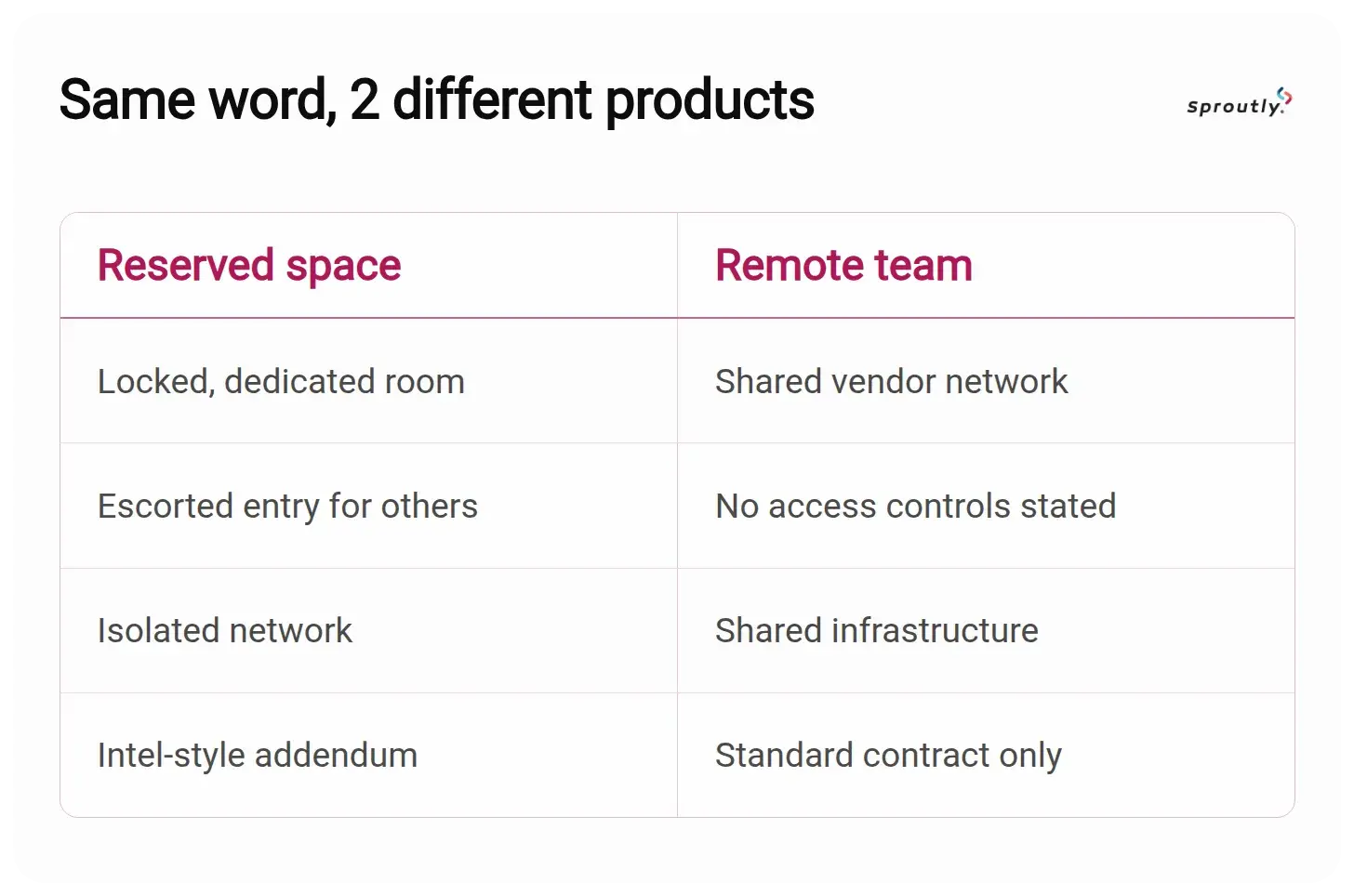
Large companies still write it that way. Intel's security addendum for suppliers defines an ODC as "a dedicated physical space allocated exclusively for Intel" on the supplier's premises, and then lists the controls that come with it: escorted entry for anyone else, frosted or covered windows, and a network kept separate from the supplier's own.
If one vendor says "ODC" and means a reserved, locked-down space, and another means a remote team on its shared network, you are comparing 2 different products. Ask each vendor which one it is offering.
Why a team in Poland can be offshore or nearshore
For a company in Virginia, teams in India and in Eastern Europe are both offshore. For a company in London, the same team in Poland is nearshore, 1 hour away. The name ODC has stuck either way (British English spells it "offshore development centre").
The number of working hours you share with the team affects your week far more than the label does. The location section below covers it.
How the offshore development center model works
The offshore development center model splits responsibility between the client and the ODC operator. The client sets product priorities, owns the backlog, and accepts delivered work, while the operator, whether a vendor or the client's own subsidiary, handles hiring, payroll, office space, equipment, and local compliance. A delivery lead inside the ODC runs daily execution and reports to the client.
|
The work |
ODC operator (vendor or your subsidiary) |
You |
|
Product roadmap and priorities |
Can challenge and advise |
Decide |
|
Hiring and interviews |
Finds and screens candidates |
Approve final hires, in most contracts |
|
Employment, payroll, benefits, local tax |
Handles |
Pays the vendor's invoice, or runs it directly if you own the subsidiary |
|
Office, equipment, network |
Provides and maintains |
Set the security requirements |
|
Daily delivery and team management |
The delivery lead runs it |
Check progress against agreed goals |
|
Code, accounts, and IP |
Works inside your systems |
Own, in your company's name |
|
Retention and career growth |
Handles |
Shape it through how much context and respect the team gets |
The line that causes the most friction is the one between managing people and directing work. The vendor's delivery lead decides who is on leave next week. You decide whether the next 2 weeks go to the billing feature or the reporting screen.
In a startup or small business, "you" in the right-hand column is usually the founder. 3 of those rows (priorities, final hires, and checking delivered work) go better with someone who understands what the team produces. If that is not you, line up a technical cofounder, an advisor, or a fractional CTO before the team starts, so the team never waits on a decision no one can make.
The 3 ODC models
Offshore development center models differ by who owns the legal entity and employs the engineers. In a vendor-hosted ODC, the vendor employs the team and the client directs the work. In a build-operate-transfer (BOT) model, the vendor builds and runs the center before transferring it to the client, and in a captive ODC, the client owns the foreign entity from day 1.
|
Vendor-hosted ODC |
Build-operate-transfer (BOT) |
Captive ODC (your own subsidiary) |
|
|
Who employs the engineers |
The vendor |
The vendor, then you after the transfer |
You |
|
Who owns the company and office |
The vendor |
The vendor, then you |
You |
|
Who directs daily work |
You, through the vendor's delivery lead |
You |
You |
|
Time to the first engineers |
Weeks |
Months |
Months to a year or more |
|
Upfront cost |
Low |
Medium: setup and transfer fees |
High: legal entity, office, local HR, recruiting |
|
What you can walk away with |
Code and knowledge, plus people only if the contract lets you hire them |
The whole center, on agreed terms |
Everything, and closing it is your cost |
|
Fits when |
You need a team soon and may grow or shrink it |
You want to own the team later, without the setup work now |
You plan a large, permanent presence in that country |
Vendor-hosted ODC
The vendor employs the engineers, provides the office and equipment, and handles local payroll and tax. The team works only on your product, and you direct what it builds.
Vendors sell this model as a dedicated team, a contractor model, or a managed ODC. Before you sign, check 3 things in the contract:
- Exclusivity in writing. The engineers named in the proposal work on your product only.
- A named delivery lead. One person on the vendor's side who is accountable to you for daily delivery.
- What happens if you part ways. Whether you can hire team members directly, at what fee, and how the handover of code, documentation, and accounts works.
Build-operate-transfer
The vendor recruits the team, sets up the office, and runs everything for an agreed period. At the end, the team and often the local company move to you.
The contract decides almost everything in a BOT arrangement. 4 terms deserve the most attention:
- Timing. The transfer can be set for a fixed date, triggered by team size, or left to your choice after a minimum period.
- The price, which might be a fixed fee, a multiple of monthly cost, or a formula tied to headcount.
- Engineers who would rather stay on the vendor's payroll. Agree now what happens to them.
- IP and accounts. Code is usually yours already, while licenses, office leases, and local registrations need their own plan.
BOT suits companies that are confident they will want their own team abroad in 2 to 3 years but do not want to set up a foreign company today.
Captive ODC
You register a company in another country, hire the engineers as your own employees, and run the office yourself. Large enterprises call these global capability centers (GCCs), and India alone had 1,580 of them in fiscal year 2023, employing about 2 million people, according to Nasscom and the research firm Zinnov.
For a startup or small business, a captive center needs things you probably do not have yet: a legal entity abroad, local payroll and tax filings, an office, local legal counsel, and a person on the ground to run it. It gives you the most control and carries the highest fixed cost, including the cost of closing it if plans change.
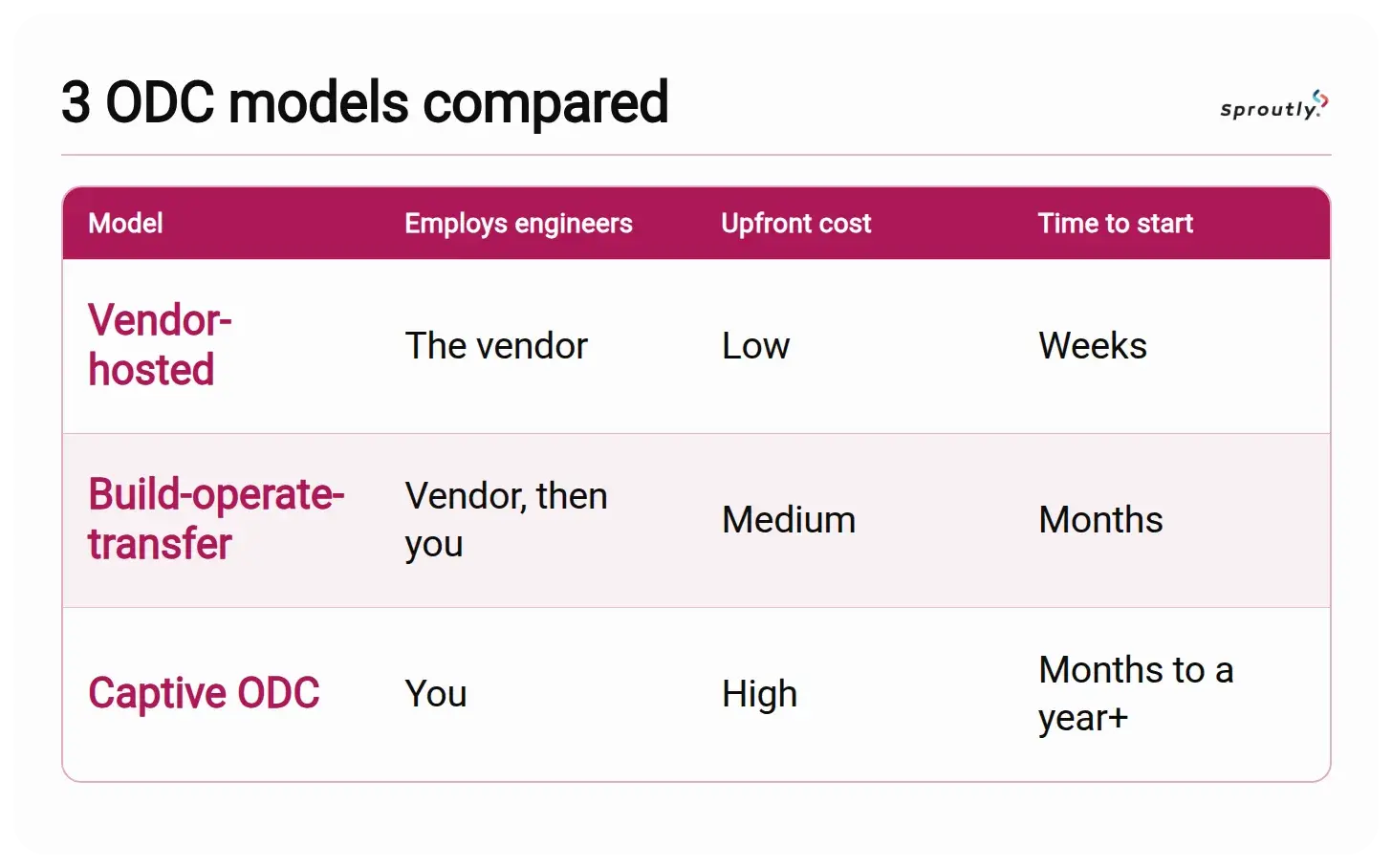
Proposals often mix these 3 models with 2 others, staff augmentation and project outsourcing, which work differently.
ODC vs dedicated team vs staff augmentation vs outsourcing
An offshore development center differs from staff augmentation and project outsourcing in scope and duration. Staff augmentation adds individual engineers to an existing in-house team, and project outsourcing hands a defined scope to a vendor that manages delivery. An ODC is a complete, exclusive team with its own lead and infrastructure, planned to run for years.
|
Model |
What you get |
Who manages daily work |
Typical length |
Exclusive to you? |
Fits when |
|
Project outsourcing |
A defined result, such as an MVP |
The vendor |
Months |
Usually not |
The scope is clear and fixed |
|
Staff augmentation |
1 or a few engineers who join your team |
You |
Months |
Yes, per person |
You have a team and need 1 or 2 more skills |
|
Dedicated team |
A full team that works only for you |
The vendor's lead, with your priorities |
A year or more |
Yes |
You need a team but have no engineering manager |
|
Offshore development center |
A self-contained team with its own lead, infrastructure, and security rules |
The ODC's lead, with your priorities |
Several years |
Yes |
You plan to keep building for years |
A dedicated team and a vendor-hosted ODC often look identical on paper, and in many contracts they are. They differ mostly in scale, in how separate the setup is, and in how long both sides plan to stay.
To tell which one a proposal describes, ask 4 questions:
- Is the team exclusive to us, in writing?
- Does it have its own delivery lead who reports to us?
- Does it run on equipment and security controls set by our requirements?
- Is it planned for at least 2 years, with a plan for growth?
4 yes answers describe an ODC, whatever the vendor calls it. Fewer than 4 describe a dedicated team or staff augmentation, which may be what you need.
If your next step is a single version 1 with a fixed scope, project outsourcing may fit better than any long-term model. Our guide to MVP development challenges covers how to scope that first build.
What an ODC costs
The cost of an offshore development center depends on location, seniority, and model. Accelerance's 2026 benchmark, based on a survey of 60 development partners, puts senior developer rates at $64 to $76 an hour in Europe, $60 to $75 in Latin America, and $31 to $41 in Asia. Management time, security setup, travel, and turnover add to these rates.
|
Region |
Junior developer |
Senior developer |
|
Europe |
$31 to $39 an hour |
$64 to $76 an hour |
|
Latin America |
$33 to $45 an hour |
$60 to $75 an hour |
|
Asia |
$24 to $31 an hour |
$31 to $41 an hour |
Source: Accelerance, 2026 rate outlook, published November 24, 2025.
Rates are the easiest line to compare across proposals, so they tend to get too much weight. In the same Accelerance report, Olivier Poulard of Global Software Engineering Strategies says: "Hourly rates are a poor measure of the true cost of software development."
On top of the rate, budget for these:
- Your own time. Someone on your side sets priorities, answers questions, and accepts finished work every week. In a small company, those hours come out of the founder's calendar unless someone else is assigned.
- Security setup, if your customers require a separate network, managed laptops, or restricted access. Ask whether it is in the rate or billed separately.
- Turnover. Each engineer who leaves takes product knowledge along, and the replacement needs weeks to catch up, so ask every vendor for average tenure on client teams.
- Setup and exit costs: close to zero for a vendor-hosted ODC, a transfer fee for BOT, and registration, legal work, and closing costs for a captive center.
We have not included a total cost range here. Totals depend on team size, seniority mix, and how much of the list above applies to you, and a single published range would mislead more readers than it helped.
What your customers' security teams will ask about an ODC
Enterprise clients often attach a security addendum to offshore development center contracts. Intel's published ODC addendum, for example, requires a dedicated space reserved for Intel work, escorted access for anyone else, a network logically isolated from the supplier's own, CCTV footage kept for at least 90 days, and removal of a worker's access within 24 hours of their last day.
If you sell to hospitals, school districts, banks, or larger companies, expect a shorter version of this list in their security questionnaires: where your developers work, and who can reach customer data. The answers depend on your ODC's setup, so ask the vendor now, before a customer asks you.
Intel's published requirements (Information Security Addendum, Appendix B, revision Q1 2024) translate into 8 questions you can send any ODC vendor:
- Is the workspace, physical or virtual, reserved for our team, with access limited to named people? Shared spaces make it harder to prove who could see your data.
- Is our network or VPN separate from your other clients' networks? Separation limits the damage if another client's project is compromised.
- Can devices used on our project connect to another network at the same time? A laptop on 2 networks at once is a bridge between them.
- How fast is access removed when someone leaves the team? Intel requires 24 hours, and immediately when the departure is hostile.
- Who keeps the list of people with access, and how often is it checked? Intel requires a review every quarter.
- Where is our data stored, and which cloud tools and email accounts can the team use with it? Personal email and unapproved file-sharing tools give data an easy way out of a project.
- What is your incident response plan, and how long do you keep incident logs? Intel asks for at least 12 months of logs.
- When did you last test your business continuity plan? Intel requires an annual test covering power, internet, and disaster scenarios.
Ask which security certifications the vendor holds, such as ISO/IEC 27001 or a SOC 2 report, and request the certificate or the report itself. A standard named on a website does not tell you whether the vendor has been audited against it.
Data rules also depend on location. The 2 below are general information, so have a lawyer review your own case.
- US sensitive data. Since April 8, 2025, the US Department of Justice Data Security Program restricts giving "countries of concern" access to bulk sensitive data about Americans, including through vendor and employment agreements. The countries are China (including Hong Kong and Macau), Russia, Iran, North Korea, Cuba, and Venezuela, so India, Poland, and Ukraine fall outside it. Thresholds include personal health or financial data on more than 10,000 people.
- EU personal data. If your product holds data about people in the EU, GDPR applies. A team in Poland works inside the EU. A team outside the EU usually needs a legal transfer mechanism in your contracts.
Choosing a location: working-hour overlap and continuity
Working-hour overlap is the main practical constraint when choosing an offshore development center location. For a 9-to-6 working day, a team in Warsaw shares about 3 hours with New York and none with San Francisco. A team in Pune, India, shares no working hours with either city, so questions and answers travel overnight.
|
Team location |
Shared hours with New York |
Shared hours with San Francisco |
|
Warsaw, Poland |
3 |
0 |
|
Kyiv, Ukraine |
2 |
0 |
|
Pune, India |
0 |
0 |
Calculated for a 9:00 to 18:00 working day in each city. The US and Europe change clocks on different dates, so overlap shifts by an hour for a few weeks each spring and autumn.
For a full comparison of locations, rates, and legal friction, see our guide to onshore vs nearshore vs offshore outsourcing.
When an ODC fits a startup or small business
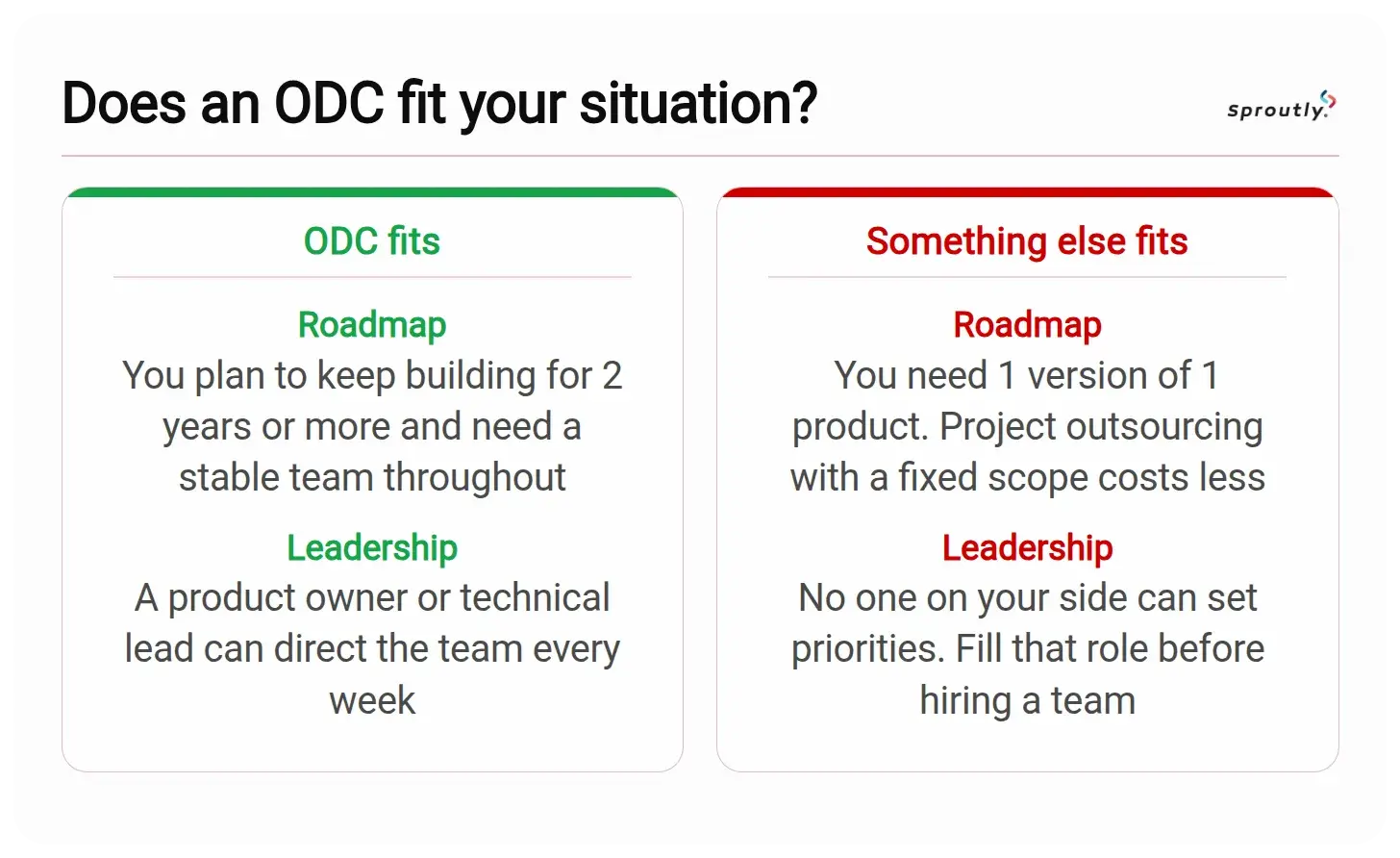
An offshore development center makes sense when a company needs a stable engineering team for 2 years or more, cannot hire fast enough locally, and has a product or engineering lead who can direct remote work. It is a poor fit for short, fixed-scope projects or for companies without an in-house owner for priorities.
An ODC is likely to fit if:
- Your roadmap runs 2 years or more, long enough for the knowledge an ODC builds to pay off.
- Local hiring cannot keep up. You need several engineers, and each local hire takes months.
- A product owner, technical cofounder, or fractional lead has time set aside every week to direct the team.
- Your customers send security questionnaires, and a reserved, separately secured team is easier to describe in one than a shared vendor pool.
Something else is likely to fit better if:
- You need 1 version of 1 product. Project outsourcing with a clear scope costs less to set up and to end.
- You are missing 1 or 2 skills, which staff augmentation can add to the team you already have.
- No one on your side can set priorities yet. Fill that role first, because an ODC with no direction spends your budget on guesses.
How to set up an ODC
Setting up an offshore development center follows 6 steps: define the team's scope and horizon, choose the model, choose the location, select the operator, agree on security and exit terms, and onboard the team with a named delivery lead. Vendor-hosted ODCs can start within weeks; captive centers take months because of company registration and recruiting.
- Define what the team will own and for how long. Write 1 page: the product areas, the skills needed in the first 6 months, and how long you expect to need the team. A written page gives every vendor the same thing to quote against.
- Choose the model. Use the models table above. Most small companies start vendor-hosted and keep BOT or captive as later options.
- Choose the location. Start from overlap with your own working day, then compare rates and data rules.
- Select the operator. Ask for references from clients whose teams have run for 2 years or more, and talk to the delivery lead who would run yours, as well as the sales team.
- Agree on security and exit terms. Send the 8 security questions, then put the exit in writing: notice period, handover of code and documentation, whether you can hire team members, and a written assignment of IP to your company. Keep your code repository, hosting, and domain accounts in your company's name from day 1.
- Onboard with a named lead on each side. The vendor's delivery lead runs the team, and your side needs one person who sets priorities and accepts work. Hold the first planning session together, in person if you can.
How can Sproutly help?
For most startups and small businesses, a vendor-hosted ODC is the fastest way to get an exclusive team without registering a company abroad. What it leaves open is the role every model depends on: someone on your side who can direct the team and make the technical calls.
Edge Sourcing™ fills that role. It connects you and a verified development partner in India or Eastern Europe through shared tools, a shared process, and a fractional product and technical lead, who we call your Edge Facilitator. Depending on the project, your Edge Facilitator acts as product manager, fractional CTO, or project manager, and works on your side of the time zone.
For one of the largest school districts in the US, with almost 20,000 employees and more than 200,000 students, we built a web app teachers use to plan daily community meetings with their students. Today a partner team develops it, and Sproutly cofounder Stephen Thomas works with the district as its Edge Facilitator. Browse more client stories.
Still deciding whether an ODC fits? Book a needs assessment and we will map your roadmap, budget, and working hours against the options. Already working with an offshore team and unsure how it is going? Schedule a team assessment for an independent, plain-language read.
You can also meet the team behind Sproutly.
References
- Intel Corporation (2024). Intel Information Security Addendum, Appendix B: Off-shore Development Center (ODC), revision Q1 2024. Intel (PDF)
- Accelerance (2025). "2026 software development outsourcing rates: Asia, Europe, and LatAm." November 24, 2025. Accelerance
- Nasscom and Zinnov, via IndBiz (2023). "India to have over 1900 GCCs by 2025: report." June 2, 2023. IndBiz
- Herbsleb, J. D., and Mockus, A. (2003). "An empirical study of speed and communication in globally distributed software development." IEEE Transactions on Software Engineering, 29(6). PDF
- Lviv IT Cluster (2026). "Gradual market stabilization: what tech services exports looked like in 2025." February 20, 2026, based on National Bank of Ukraine data. Lviv IT Cluster
- US Department of Justice (2025). Data Security Program, 28 CFR Part 202, effective April 8, 2025. Summary via Cornell Research Services
FAQ
What does ODC mean in IT?
ODC stands for offshore development center: a software team in another country that works only for 1 client over several years. In IT services contracts, the term originally meant a physical, access-controlled area in the vendor's office reserved for 1 client. Many large companies, Intel among them, still write their ODC security requirements that way.
What is the difference between an ODC and outsourcing?
The main differences are exclusivity and time. Project outsourcing delivers a defined scope, and the vendor manages how it gets done. An ODC is a team that works only for you for years, and you direct what it builds. Outsourcing fits a single build with a fixed scope. An ODC fits a product you plan to keep developing.
What is the difference between an ODC and a GCC?
A global capability center (GCC) is an offshore unit a company owns and staffs itself. A captive ODC is a type of GCC. A vendor-hosted ODC is not a GCC, because the vendor employs the team and owns the local company. Build-operate-transfer starts vendor-hosted and can end as a GCC once the team moves to you.
What is the difference between an ODC and BOT?
Build-operate-transfer (BOT) is 1 of the 3 ODC models. A vendor builds and runs your team, then transfers it to you on agreed terms. The contract decides how well BOT works. Check when the transfer can happen, how the price is calculated, what happens to people who do not want to move, and how licenses and accounts change hands.
How long does it take to set up an offshore development center?
A vendor-hosted ODC can usually start within weeks, because the vendor already has an office, payroll, and a hiring pipeline.