
Say you have 3 quotes for what you thought was the same app. One says $40,000. Another says $140,000. The third sits in between, and you cannot tell which vendor understood the idea and which one guessed. None of them asked what you are trying to learn from version 1.
That missing answer is where most startups' MVP development challenges begin. The feature list grows, the team fills in the blanks, and the budget runs out before anyone finds out whether customers want the product.
The technical trouble shows up later. Rework, blown estimates, and a launch that teaches you nothing look like MVP software development challenges, and most of them trace back to a scope that was never written down.
Below are eight MVP development challenges and solutions, grouped by when they hit: before the build, during it, and at launch. Each solution is a decision you can make yourself, without reading code. At the end, you will find a quick-reference table and a 1-page scope you can fill in this week.
What an MVP is for (and why that decides everything else)
Eric Ries, who popularized the term with The Lean Startup, defined the minimum viable product in 2009 as "that version of a new product which allows a team to collect the maximum amount of validated learning about customers with the least effort."
A shorter working version: an MVP is the cheapest thing you can build that answers your riskiest question.
Sometimes that thing barely counts as software. Before Dropbox's product was ready, Drew Houston released a 3-minute demo video. Ries reports that the beta waiting list went from 5,000 to 75,000 people overnight. The video answered the demand question before the full product existed.
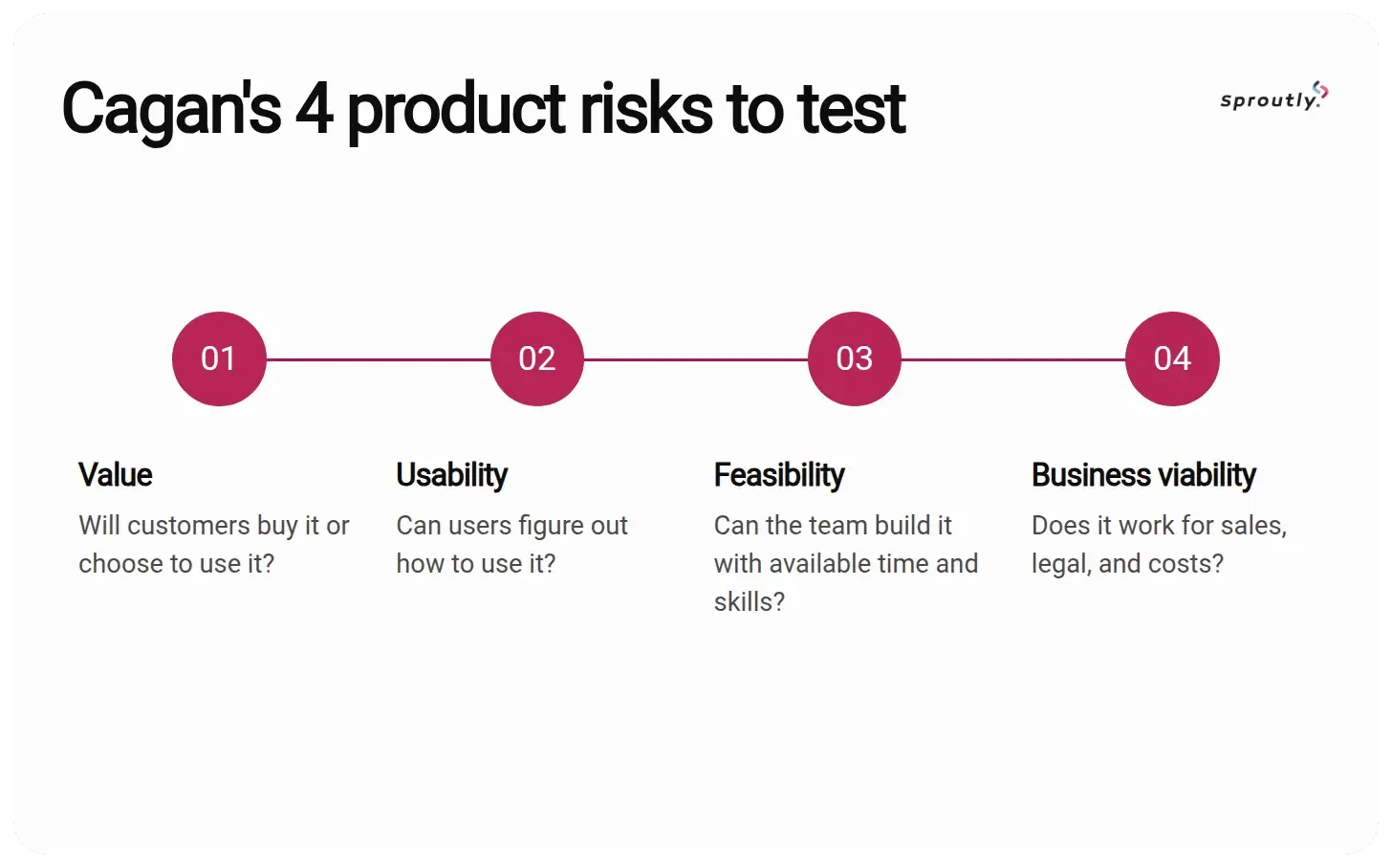
To find your riskiest question, use product leader Marty Cagan's 4 product risks:
- Value: will customers buy it, or choose to use it?
- Usability: can users figure out how to use it?
- Feasibility: can the team build it with the time, skills, and technology available?
- Business viability: does it work for the rest of the business, such as sales, legal, and costs?
For a new product, value usually comes first. CB Insights' 2026 analysis of 431 VC-backed shutdowns found poor product-market fit in 43% of cases.
If you cannot say which question your MVP answers, the common MVP mistakes below get harder to avoid.
Before the build: 4 MVP challenges that start with definition
The first 4 challenges happen before anyone writes code, and they shape everything the team builds after.
Startup Genome's 2011 study of about 3,200 startups points the same way. Startups that scaled prematurely wrote 3.4 times more code in the discovery stage than startups that grew consistently. The data is old, so read it as a directional pattern: the teams that struggled were building before they had settled what to build.
1. The MVP has no question to answer
What it looks like. The goal is "launch the app." Ask the team what result would make you keep going, change direction, or stop, and no one has an answer.
Why does it happen? Founders often plan the MVP as a smaller copy of the final product. Without a hypothesis, every feature looks equally important, so the scope has no way to shrink.
The decision to make. Write 1 sentence and share it with everyone working on the product:
"We believe [type of user] will [specific behavior] because [reason]. We will know we are right if [measurable signal] by [date]."
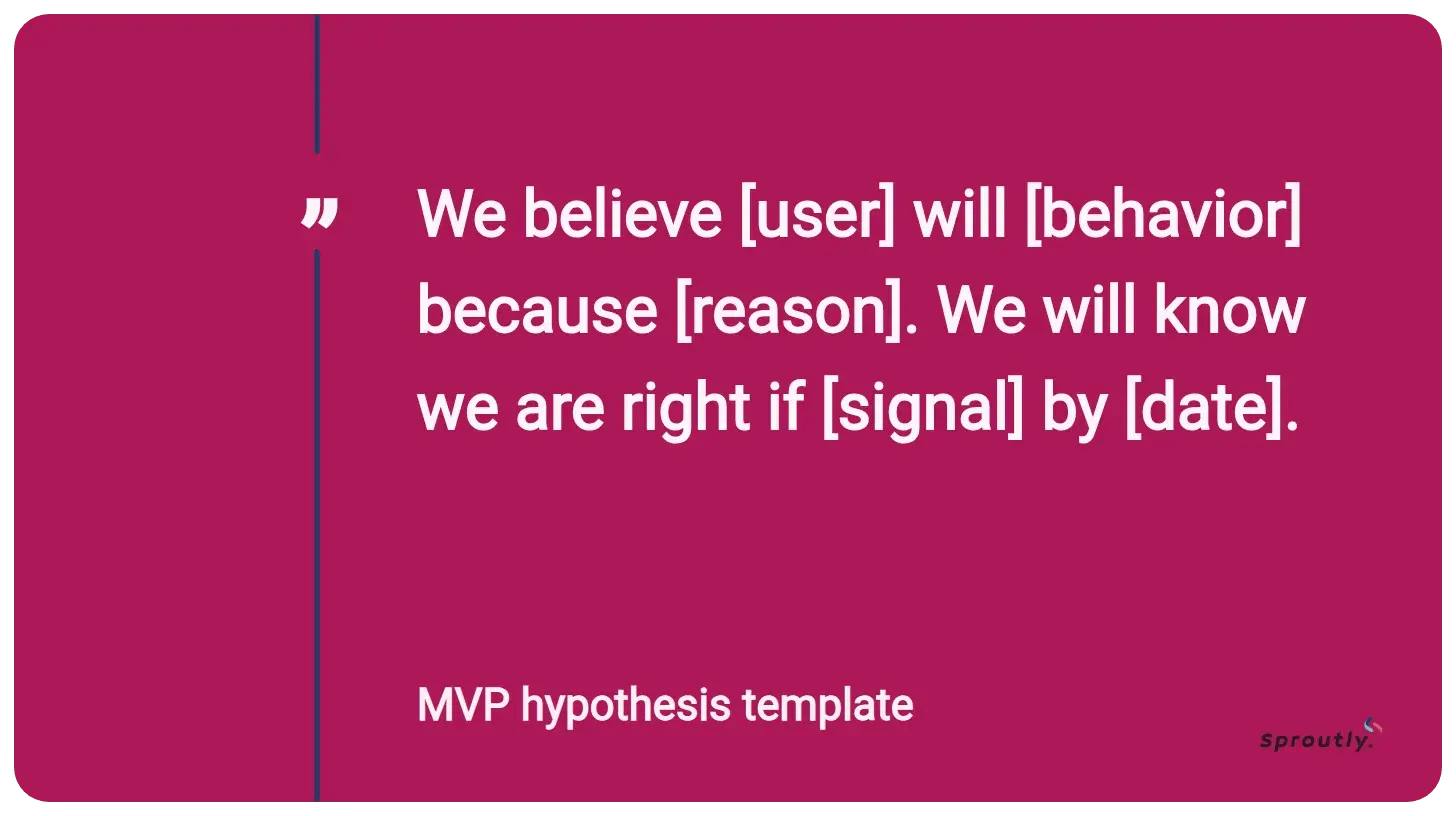
For example: "We believe independent dog groomers will take bookings through a shared calendar because they lose clients to missed texts. We will know we are right if 30 groomers each take 5 or more bookings through the app within 6 weeks of launch."
That sentence tests value, and it tells you which features matter: the ones a groomer needs to take a booking.
What good looks like. A 1-sentence hypothesis and 1 to 2 success metrics, agreed before the first sprint. Anyone on the team can repeat it back without looking it up.
2. The feature list keeps growing
What it looks like. Every conversation with an advisor, investor, or friend adds a feature. The "must-have" list now has 30 items, and none have come off.
Why does it happen? Cutting a feature feels like a risk. Adding one feels like progress. Each addition is small and easy to defend, so the total grows unnoticed.
This is MVP feature creep, and it happens well beyond MVPs. Pendo's 2019 Feature Adoption Report, based on 3 months of usage data from 615 Pendo customer subscriptions, found that 80% of features in the average software product are rarely or never used. The data covers established products, so treat it as a general pattern. It shows how easily teams build more than their users need.

The decision to make. Sort every feature into 3 columns:
- Needed to test the hypothesis. The features a user must touch for you to get your signal.
- Needed for the product to work at all. Login, payments, and legal requirements such as privacy terms.
- Everything else.
Only columns 1 and 2 go into version 1. Column 3 becomes your "not in version 1" list. Keep it, because the good ideas on it are the start of your roadmap.
What good looks like. A written "not in version 1" list that is longer than the "in version 1" list.
3. Requirements live in your head, so the team guesses
What it looks like. You describe the app on calls. The team builds something close, and every demo ends with "that is not what I meant."
Why does it happen? Spoken requirements feel clear to the person speaking. Developers fill the gaps with assumptions, and assumptions are expensive to undo once they are built into the code.
PMI's 2014 Pulse of the Profession report on requirements management found that 47% of unsuccessful projects missed their goals because of inaccurate requirements management.
The decision to make. Before development starts, write user stories with acceptance criteria for every feature in scope. A user story is a 1-sentence description of what a user needs to do and why. Acceptance criteria are the conditions the feature must meet to count as done.
Using the groomer example:
User story: As a groomer, I want to see all of tomorrow's bookings on 1 screen, so I can plan my day.
Acceptance criteria: Bookings appear in time order. Each shows the client's name, the dog's name, and the service booked. Cancelled bookings do not appear.

What good looks like. Every in-scope feature has a written "done means" line you can check yourself by clicking through the software. Written stories are also how you scope an MVP so that 2 vendors quote the same thing.
4. The build approach gets picked before the problem
What it looks like. "No-code, because it is cheap." "Custom, because investors expect it." "I will build it myself with AI tools." Each decision gets made before the scope exists.
Why does it happen? Each approach is good at different things. No-code is fast for testing demand, and it can hit limits on custom logic and on who owns the data. AI coding tools get you to a working demo quickly, and the security gaps are easy to miss when nobody reviews the output.
Veracode's 2025 GenAI Code Security Report tested more than 100 large language models on coding tasks in Java, JavaScript, Python, and C#. In 45% of the tests, the generated code introduced a security flaw from the OWASP Top 10, a widely used list of the most serious web application risks.
Use that finding as a reason to add a code review before real users and real data reach the product. AI-assisted builds can still be the right call for an MVP.
|
No-code |
Custom build |
AI-assisted build |
|
|
Speed to first version |
Fastest |
Slowest of the 3 |
Fast to a demo |
|
Upfront cost |
Lowest |
Highest |
Low, plus review time |
|
Good for |
Testing demand, simple workflows, internal tools |
Custom logic, integrations, code meant to carry into version 2 |
Prototypes, demos, early tests with a technical reviewer |
|
Main risk |
Platform limits on custom logic, data ownership, and moving off later |
Spending the budget before the hypothesis is tested |
Security gaps no one reviews |
|
In version 2 |
Often rebuilt if the product outgrows the platform |
Extended, if built with tests and review |
Kept only after review and cleanup |
The decision to make. Choose the approach after you have the hypothesis and the scope, using 3 questions:
- Does the test need real users entering real data? If yes, security and data handling matter from day 1.
- Will any of this code survive into version 2? If yes, build it to be maintained, with tests and documentation.
- Who will review the code before users touch it? Name a person, even if it is an outside reviewer for a few hours.
What good looks like. A short written rationale for the build approach that refers back to the hypothesis, plus a named person responsible for code review.
During the build: 3 challenges that cost time and budget
5. The team is chosen on price and speed of the quote
What it looks like. The cheapest or fastest quote wins. The vendor never asked about your users, your hypothesis, or what happens after launch.
Why does it happen? Without a written scope, quotes cannot be compared. A low quote can mean a smaller reading of the same idea. A high one can include features you never asked for.
Startup Genome's 2011 report also found that startups that scaled prematurely outsourced 4 to 5 times as much of their product development as consistent ones. That is a correlation, and the finding is about building too much too early. Outsourcing MVP development works well for many startups. The risk comes from outsourcing before the scope is settled, which leaves the vendor to define it for you.
The decision to make. Send every vendor the same 1-page scope (there is a template below) and compare how they respond. Good vendors push back, ask questions, and suggest cuts.
What good looks like. A vendor who asks "what are you trying to learn?" in the first call and proposes a smaller first release than the one you described.
6. The wrong corners get cut
What it looks like. To hit the date, testing gets skipped, security moves to "later," and the codebase grows without review. Or the reverse: weeks go into polish and scale that version 1 does not need.
Why does it happen? The team applies "minimum" evenly across the product. Some parts can be rough in version 1. Others carry legal, financial, or security risk from the first user.
The decision to make. Agree on 2 lists with your team before the first sprint:
|
Safe to skip in version 1 |
Never safe to skip |
|
Scale for large numbers of users |
Authentication and data security |
|
Admin dashboards (manual workarounds are fine early on) |
Payment handling |
|
Polish on secondary screens |
Legal and compliance requirements |
|
Edge-case features |
Automated tests on the core user flow |
|
Your ownership of the code and accounts |
Tow Ninja, a towing app, came to Sproutly with a partial MVP from a previous developer. Its pilot in Harrisonburg, VA had to meet the city's legal reporting requirements.
Sproutly reviewed the code, fixed the priority issues, and added unit testing and a CI/CD pipeline (an automated process that tests and releases new code). The team then built the missing features. The pilot launched and met the city's reporting requirements. Testing and compliance were the 2 corners that could not be cut. Read how we finished a partial MVP.
What good looks like. Every shortcut is written down as known technical debt (work that will need redoing later), with a plan for when to revisit it. The team comes back to it on purpose.
7. You cannot see progress until it is too late
What it looks like. Updates say "on track" for weeks. The first time you click through working software is a month before launch.
Why does it happen? MVP timelines are short, so a 3-week blind spot covers a large share of the build, and little budget is left by the time you see the gap.
The decision to make. Ask for a link to the staging environment (a private copy of the product where the team tests new work) from week 2. Then ask for a working demo at the end of every sprint. A sprint is a fixed work cycle, usually 2 weeks, so that means a live demo every 2 weeks.
What good looks like. You can open the current version yourself at any time, and you use it.
For the full diagnostic, see signs your dev team is behind.
At launch: the challenge that decides whether the MVP was worth it
8. Launch day arrives with no plan to learn from it
What it looks like. The app goes live. Analytics are not set up, nobody is assigned to talk to users, and the next sprint is already full of new features.
Why does it happen? The build takes everyone's attention for months, and launch feels like the finish line. Yet the hypothesis from challenge 1 can only be tested after launch.
The decision to make. Before launch day:
- Set up tracking for the 1 to 2 success metrics from challenge 1, and check that the numbers come through.
- Line up 10 to 20 early users you can speak with in the first weeks. Pair what they tell you with what the analytics show, since people often describe their behavior differently from how they act.
- Write down the decision rule in advance: which result means continue, which means change, and which means stop. Deciding after you see the numbers makes a weak result easy to explain away.
Later, once you have regular users, Sean Ellis's product-market fit survey gives you a second check. It asks, "How would you feel if you could no longer use this product?" Ellis's rule of thumb, described in Hacking Growth (2017), is that 40% or more answering "very disappointed" suggests product-market fit. Treat it as a practitioner heuristic.
What good looks like. A review meeting already on the calendar 4 to 6 weeks after launch, with the hypothesis on the first slide.
Some MVP code is meant to be thrown away. A no-code prototype that proves demand has done its job even if version 2 is a full rebuild. Decide which kind you are building before the build starts (challenge 4), so a rebuild arrives as part of the plan.
Quick reference: MVP development challenges and the decision that prevents each
Screenshot this table, or paste the middle column into your project plan.
|
Challenge |
When it hits |
The decision that prevents it |
What good looks like |
|
No question to answer |
Before the build |
Write a 1-sentence hypothesis |
Team can repeat it back |
|
Growing feature list |
Before the build |
Sort features into 3 columns |
"Not in v1" list is longer |
|
Requirements in your head |
Before the build |
User stories + acceptance criteria |
Every feature has "done means" |
|
Approach picked too early |
Before the build |
Choose approach after scope |
Written rationale + code reviewer |
|
Team picked on price |
During the build |
Same 1-page scope to every vendor |
Vendor proposes cuts |
|
Wrong corners cut |
During the build |
Agree "skip" and "never skip" lists |
Debt is written down |
|
No visibility |
During the build |
Staging link from week 2 |
You can click through any time |
|
No plan to learn |
At launch |
Metrics, users, and a decision rule |
Review meeting already booked |
Read top to bottom, the table shows how 1 gap turns into the next. Without a hypothesis, nothing stops the feature list from growing. A long list that lives in your head forces the team to guess, and guesses make quotes impossible to compare. A launch with no metrics cannot answer a question nobody wrote down.
A 1-page MVP scope you can fill in this week
This page pulls the 8 decisions into 1 document, the MVP scope you send to vendors. Each field takes 1 to 3 sentences.
- The problem and who has it. Name a specific type of user and the problem you have seen them struggle with.
- Hypothesis. The sentence from challenge 1, with the signal and the date filled in.
- Riskiest question. Which of Cagan's 4 risks your MVP tests first (value, usability, feasibility, or viability), and why that one.
- Success metrics and decision rules. 1 to 2 metrics, plus the results that mean continue, change, or stop.
- In version 1 / not in version 1. Columns 1 and 2 from the feature sort, then the parked list.
- Never-skip list. Security, payments, legal, tests on the core flow, and ownership of code and accounts, with a note on how each is handled.
- Build approach and why. No-code, custom, or AI-assisted, your answers to the 3 questions from challenge 4, and the name of your code reviewer.
- Budget and timeline range. A range you can live with, plus what you would cut first if either runs over.
Send the finished page to every vendor you talk to. Their questions back will tell you more than their quotes.
If you would like a second pair of eyes on yours, book your MVP scoping session with Sproutly.
How Sproutly helps
Sproutly works with startups and small businesses that build software with outsourced teams. Our model has 3 steps: define, assess, and monitor.
Step 1 is to define and clarify what you are building, before anyone sources a team or writes code. That step covers the gap this article describes: the hypothesis, the scope, and the decision rule that first builds often skip. Steps 2 and 3 cover finding or assessing your team, then monitoring the build.
When Tow Ninja came to us with a partial MVP, we reviewed the code, added the testing the pilot needed, and built the missing features. The pilot launched and met local legal reporting requirements.
Bring your idea, your feature list, or a half-finished build, and book your MVP scoping session. We will work through what version 1 needs to prove and what can wait.
References
- Ries, E. (2009). "Minimum Viable Product: a guide." Startup Lessons Learned. startuplessonslearned.com
- Ries, E. (2011). The Lean Startup. Crown Business.
- Ries, E. (2011). "How DropBox Started As A Minimal Viable Product." TechCrunch. TechCrunch
- Cagan, M. "The Four Big Risks." Silicon Valley Product Group. SVPG
- CB Insights (2026). "The top reasons startups fail." CB Insights
- Startup Genome (2011). Startup Genome Report Extra on Premature Scaling. PDF
- Pendo (2019). The 2019 Feature Adoption Report. Pendo
- Project Management Institute (2014). Pulse of the Profession: Requirements Management, A Core Competency for Project and Program Success. PMI
- Veracode (2025). 2025 GenAI Code Security Report. Veracode
- Ellis, S., and Brown, M. (2017). Hacking Growth: How Today's Fastest-Growing Companies Drive Breakout Success.
FAQ
What is the biggest challenge in MVP development?
Deciding what the MVP must prove. Without a written hypothesis and a success metric, every feature looks equally important, the team fills gaps with guesses, and launch produces no clear answer. Most other MVP development challenges, from feature creep to blown budgets, follow from skipping that step. Write the hypothesis before you collect quotes.
How many features should an MVP have?
As few as you need to test your hypothesis and run safely. There is no fixed number.
Sort every feature into 3 columns: needed to test the hypothesis, needed for the product to work at all (login, payments, legal), and everything else. Build only the first 2 columns in version 1, and keep the third as your roadmap.
How long does MVP development take?
It depends on scope, build approach, and team. A tightly scoped no-code test can launch much faster than a custom build with payments and integrations. The most reliable way to shorten the timeline is to cut scope before development starts.
Should a non-technical founder build an MVP with no-code or AI tools?
Sometimes, especially to test demand before paying for a custom build. Both work well for prototypes and early tests. Before real users enter real data, have someone technical review the code or setup. Veracode's 2025 research found security flaws in 45% of AI-generated code tests. Also confirm that you own the data and the accounts.
Why do MVPs fail?
Often because the product does not meet a strong enough need. CB Insights' 2026 analysis of 431 VC-backed shutdowns lists poor product-market fit in 43% of cases. Running out of money (70%) is usually the final cause. A common root cause is building without a defined hypothesis, so the budget is spent before the team learns whether customers want the product.