
The nearshore team looked like the sensible middle option. Developers in Mexico City or Bogotá, working roughly your hours, at rates well below a US agency. Six months in, the picture is less clear. The monthly invoice is higher than the estimate. The demo date moved twice. When you ask whether the code is in good shape, the answer is "yes," and you have no way to check it.
At that point, most founders start looking at alternatives to nearshore software development outsourcing. This guide covers 8 of them: what each one changes, what it costs in dollars and in your own time, and which problem it solves.
One disclosure before we start. Sproutly works with onshore, nearshore, and offshore teams, and our preferred development partner is offshore. We apply the same scrutiny to that option as to every other one on this list.
Key takeaways
- Name the problem first. Cost, visibility, skills, ownership, and data rules each point to a different alternative. A new country will not fix a management gap.
- Every alternative changes one of three things: where the developers sit, who employs them, or who manages the daily work.
- Offshore costs about half as much per hour.Senior rates in Asia run $31 to $41 an hour, compared with $60 to $75 in Latin America (Accelerance, 2026). Coordination eats part of that gap.
- In-house is the most expensive option and the one you own outright.The median US software developer salary of $135,980 becomes roughly $194,000 once benefits are added.
- Switching has a one-time cost.Before you sign with anyone new, budget for a code review and a handover. If you are unsure whether you need to switch at all, start with7 signs your dev team is behind.
Name the problem before you choose a new model
Nearshore software development outsourcing is the practice of hiring a development company in a nearby country, typically one to three time zones away, to build or maintain software. For US companies, nearshore usually means Latin America, such as Mexico, Colombia, or Brazil. Companies look for alternatives when cost, progress visibility, skill gaps, code ownership, or data rules make the arrangement a poor fit.
When a nearshore arrangement goes wrong, the cause usually sits in one of five places. Each one points to a different fix.
|
What is going wrong |
What it looks like |
Alternatives to look at first |
|
Cost |
Invoices run above the estimate, or rates went up at renewal |
Offshore outsourcing, an offshore team with a local lead, freelancers for small scopes |
|
Visibility |
Updates say "on track," but dates keep moving and you cannot judge the work |
A local lead on your side, staff augmentation under your own technical lead |
|
Skills |
The vendor cannot staff a specific role, such as an AI or data engineer |
Staff augmentation, freelancers, direct hiring through an employer of record |
|
Ownership |
The product is your business, and the knowledge lives with the vendor |
In-house hiring, an employer of record |
|
Data rules |
You handle health, financial, or other sensitive data with location limits |
Onshore outsourcing, in-house hiring |
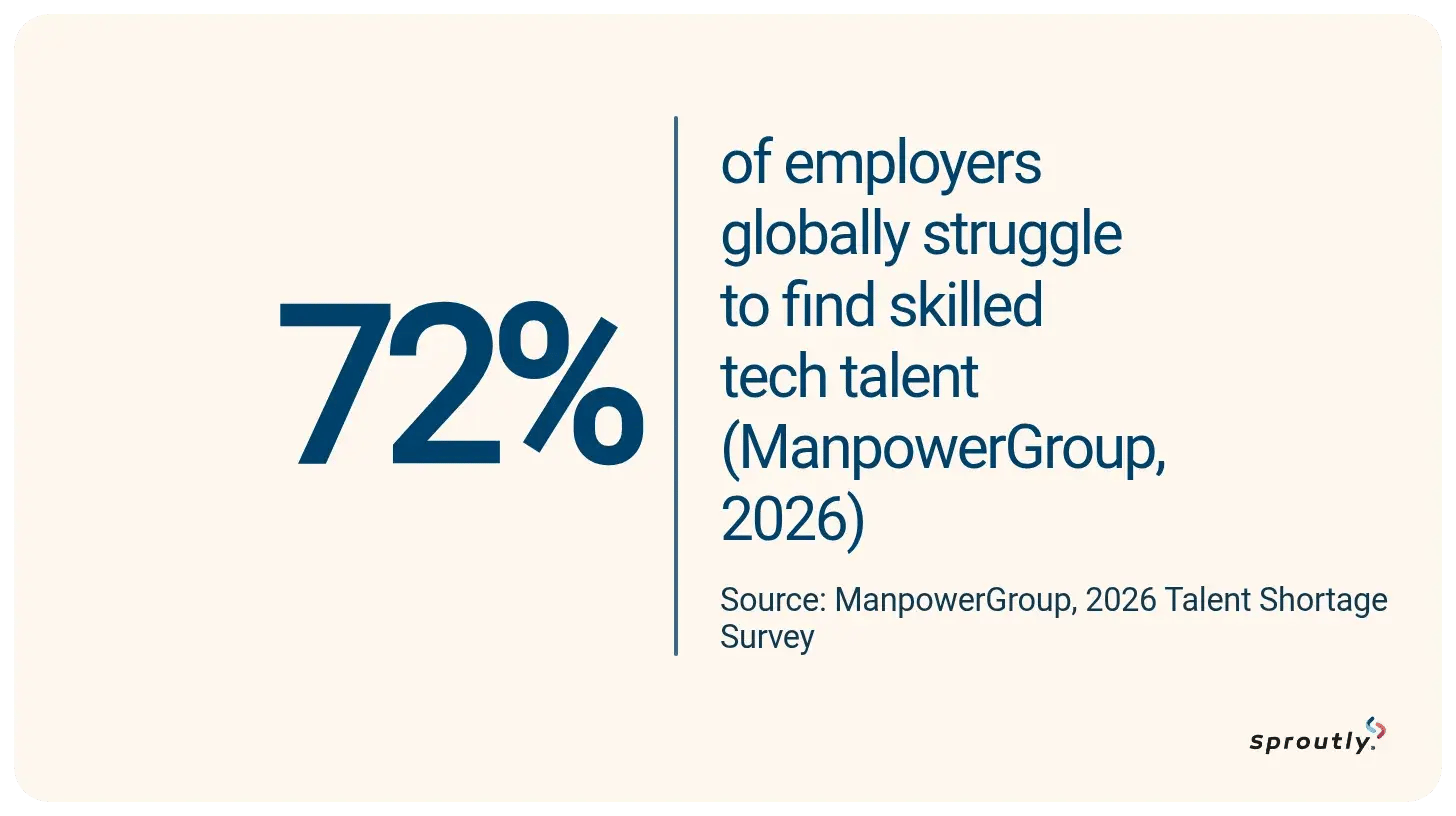
Skill gaps are getting harder to close everywhere. In ManpowerGroup's 2026 Talent Shortage Survey of 39,063 employers in 41 countries, 72% reported difficulty finding skilled talent. AI model and application development ranked as the hardest skill to hire for, cited by 20% of employers.
The visibility problem deserves a closer look before you move anything. If you cannot tell whether a project is on track with your current team, you will have the same blind spot with the next one. Changing the country moves the problem without solving it.
Three things an alternative can change
Every alternative to nearshore outsourcing changes at least one of three variables: where the developers sit, who employs them, and who manages their daily work. Location sets time-zone overlap, hourly rates, and legal exposure. Employment sets who carries payroll, benefits, and labor-law risk. Management sets who decides priorities, reviews the work, and answers for missed dates.
A typical nearshore arrangement fixes all three. The developers sit in a nearby country, the vendor employs them, and the vendor's project manager runs the work.
Each alternative in this guide moves one or more of those settings:
- Location:onshore and offshore outsourcing keep the vendor model and change the country.
- Employer:in-house hiring and an employer of record put the developers on your payroll or under your direction.
- Manager:freelancers, staff augmentation, and a local lead change who runs the work day to day.
We covered location in depth, including time zones, rates by region, and data rules, in onshore vs nearshore vs offshore outsourcing: how to choose. This guide spends more time on the other two variables, because that is where founders tend to have the fewest options in view.
8 alternatives to nearshore outsourcing at a glance
The main alternatives to nearshore software development outsourcing are onshore outsourcing, offshore outsourcing, in-house hiring, remote hiring through an employer of record, freelancers, staff augmentation, an outsourced team with an independent local lead, and no-code or AI-assisted building. Each one trades cost against control and against the time the founder must spend managing the work.
- Onshore outsourcing:best for sensitive data and work that needs in-person sessions.
- Offshore outsourcing:best for well-specified work when budget is the main constraint.
- In-house hiring:best when the software is the core of the business for years to come.
- Employer of record (EOR):best when you have found a specific developer abroad.
- Freelancers:best for small, clearly defined pieces of work.
- Staff augmentation:best when you already have a technical lead who can direct developers.
- An outsourced team with an independent local lead:best when you want offshore rates and a daytime point of contact on your side.
- No-code and AI-assisted building:best for testing an idea before you pay for a team.
|
Alternative |
What changes |
Cost basis |
Your time each week |
Your control |
Best for |
|
Onshore outsourcing |
Location |
Highest agency rates |
Low to medium |
Medium |
Regulated data, in-person work |
|
Offshore outsourcing |
Location |
31–41/hour senior (Asia) |
Medium to high |
Medium |
Defined features, testing, maintenance |
|
In-house hiring |
Employer |
~$194,000/year fully loaded (US median) |
High |
Highest |
Core product, long-term roadmap |
|
Employer of record |
Employer |
Local salary + ~$599/month fee |
High |
High |
A specific developer abroad |
|
Freelancers |
Manager |
Varies widely by person |
High |
Medium |
Short, defined tasks |
|
Staff augmentation |
Manager |
Similar to agency rates |
High |
High |
Adding capacity to a working team |
|
Outsourced team + local lead |
Manager |
Team rate + lead fee |
Low to medium |
Medium to high |
Non-technical founders with outsourced teams |
|
No-code / AI tools |
Who builds |
Tool subscriptions + your time |
Very high |
High |
Prototypes, idea validation |
Change the location: onshore and offshore outsourcing
Onshore and offshore outsourcing keep the vendor model and change the country. Onshore outsourcing places the team in the United States, which gives a full shared workday and one legal system at the highest hourly rates. Offshore outsourcing places the team in a distant, lower-cost market such as India, where senior rates are roughly half of Latin American rates and real-time overlap is limited.
1. Onshore outsourcing
An onshore development company is based in your own country. For a US founder, that means a US agency with US contracts, US business hours, and a team you can meet in person.
When it beats nearshore: you handle sensitive data with location limits, your buyers require domestic vendors, or the product depends on hardware, field testing, or regular in-person workshops.
What it costs you: the highest hourly rates of any outsourcing option. The rate data used in this guide covers Latin America, Europe, and Asia, so for US agencies collect at least three quotes and compare them against the fully loaded cost of an in-house hire.
Watch for: onshore agencies that subcontract the actual development abroad. Ask where every developer on your project sits, and get the answer in the contract.
2. Offshore outsourcing
An offshore team sits far from you, typically 8 or more hours away. For US companies, the largest offshore markets are in South and Southeast Asia. Eastern Europe also counts as offshore by time difference: Warsaw is 6 hours ahead of New York.
When it beats nearshore: the work is well specified, can move forward without daily live discussion, and cost is your main constraint. Testing, maintenance, and clearly scoped features fit this model well.
What it costs you: senior developers in Asia cost $31 to $41 an hour, against $60 to $75 in Latin America and $64 to $76 in Europe, according to Accelerance's 2026 rates data. The savings come with longer feedback loops. Pune is 9.5 to 10.5 hours ahead of US Eastern time, so a question you send at 2 p.m. often gets its answer the next morning. In a well-known IEEE study, work that involved distributed teams took about 2.5 times as long as work done at one site (Herbsleb and Mockus, 2003).
Watch for: the promise to "overlap with US hours." Ask who will be online at 2 p.m. Eastern, for how many hours, and how many days a week. Then ask what happens when that person is on leave.
Change who employs the developers: in-house hiring and an employer of record
In-house hiring and employer of record (EOR) hiring move developers onto the company's own team. In-house hiring gives the most control and the slowest start. An employer of record legally employs a developer in another country on the company's behalf, handling payroll, taxes, and local labor law for a monthly fee, while the company directs the work.
3. In-house hiring
Hiring your own developers puts the knowledge, the code, and the priorities fully under your roof. Deloitte's 2024 Global Outsourcing Survey reports that insourcing is on the rise and that in-house centers are regaining momentum.
When it beats nearshore: the software is your product, you expect to build on it for years, and you can afford at least one senior hire.
What it costs you: the median US software developer earned $135,980 in May 2025, according to the US Bureau of Labor Statistics. Benefits make up 30% of employer compensation costs in private industry (BLS, June 2026). Applied to that median salary, the total comes to roughly $194,000 a year, before recruiting fees, equipment, and software licenses. Hiring also takes time: plan for several months from job post to a developer shipping code.
Watch for: the management job that comes with the hire. One developer needs someone to set priorities, review work, and make architecture calls. If that person is you and you are not technical, budget for outside help with hiring and reviews.
Larger companies sometimes go one step further and open their own engineering office abroad. That model only pays off at dozens of engineers, so we leave it out of this list.
4. Remote hiring through an employer of record
An employer of record is a company that legally employs a person in another country for you. It handles the local contract, payroll, taxes, and benefits. You choose the person and direct the work.
When it beats nearshore: you have found a specific developer abroad, you want them on your team long term, and you do not want to open a legal entity in their country.
What it costs you: the developer's local salary plus the EOR fee. Deel lists its EOR service at $599 per employee per month, billed month to month. You still recruit, onboard, and manage the person yourself.
Watch for: non-solicitation clauses. If the developer you want currently works for your nearshore vendor, your contract may forbid hiring them directly, or require a fee. Read that clause before you make an offer. As headcount in one country grows, ask a lawyer about local employment and tax obligations.
Change who manages the work: freelancers, staff augmentation, and a local lead
Freelancers, staff augmentation, and an independent local lead change who runs the development work day to day. Freelancers are individual contractors managed by the client. Staff augmentation adds vendor-employed developers to the client's own team, under the client's technical leadership. An independent local lead is a technical or product professional, separate from the vendor, who manages an outsourced team on the client's behalf.
5. Freelancers
Freelancers are independent developers you contract directly, usually by the hour or by the project.
When it beats nearshore: the work is small and well defined. A landing page, an integration with a payment provider, a security review, or a prototype to test with five customers all fit.
What it costs you: rates vary more than in any other model, from well below offshore agency rates to well above onshore ones. The hidden cost is coordination. With three freelancers, you are the project manager, the architect, and the person who makes their work fit together.
Watch for: continuity and ownership. Make sure every contract assigns the code and intellectual property to your company, and that your company, rather than the freelancer, owns the code repository and hosting accounts.
6. Staff augmentation
With staff augmentation, a vendor employs the developers and you direct them. They join your standups, use your tools, and follow your technical lead's decisions. The vendor can be onshore, nearshore, or offshore, so the decision is about management, whatever the location.
When it beats nearshore outsourcing: you have a technical lead or CTO who can direct the work, and you need more capacity or one specific skill quickly.
What it costs you: hourly rates similar to project outsourcing in the same region. Responsibility for delivery moves from the vendor to your lead.
Watch for: staff augmentation without a technical lead on your side. Developers then wait for direction that nobody is qualified to give, and the bill keeps running.
7. An outsourced team with an independent local lead
This option keeps an outsourced team, often offshore, and adds a person on your side who manages it. That person might be a fractional CTO, a technical product manager, or a facilitator in your time zone. Their job is to turn your goals into clear requirements, review the team's work, run check-ins, and tell you in plain language where the project stands.
When it beats nearshore: you want offshore rates, you are not technical, and you need someone available during your workday who can judge whether the work is good.
What it costs you: the team's rate plus the lead's fee. Compare that total with a nearshore team managed by the vendor alone.
Watch for: independence. The lead should not work for the development vendor. A lead paid by the vendor has the same incentive to report "on track" as the vendor's own project manager.
Full disclosure: this is the model Sproutly runs, so read our view of it with that in mind.
Build it yourself first: no-code and AI-assisted development
No-code and AI-assisted development let founders build early versions of a product without hiring a development team. No-code platforms provide visual builders, and AI coding assistants generate code from plain-language prompts. In the 2025 Stack Overflow Developer Survey, 84% of developers said they use or plan to use AI tools, but 46% said they distrust the accuracy of AI output.
8. No-code and AI tools
When it beats nearshore: you are still testing whether anyone wants the product. A clickable prototype or a simple working version can answer that question before you sign a development contract.
What it costs you: tool subscriptions cost little. Most of the cost is your own time, and that grows quickly once the product needs user accounts, payments, or integrations.
Watch for: code that looks finished and is not. In the same Stack Overflow survey, 66% of developers named "AI solutions that are almost right, but not quite" as their top frustration, and 72% said vibe coding is not part of their professional work. If an AI-built prototype gets real users, plan for an experienced developer to review its security and structure before you build on it. We cover this decision in more detail in8 MVP development challenges, and how to scope around them.
How to choose the right alternative
Choosing an alternative to nearshore outsourcing starts with five questions: who on the company's side can make technical decisions, what exactly is failing in the current setup, how long the company will need the team, what the full yearly budget covers, and who must own the code and product knowledge in two years. The answers rule out most options quickly.
Work through these in order. Each answer narrows the list.
|
Question |
If your answer is… |
Shortlist |
Usually rule out |
|
Who on your side can make technical decisions? |
Nobody yet |
Outsourced team with a local lead, onshore outsourcing |
Staff augmentation, freelancers |
|
A CTO or senior developer |
Staff augmentation, EOR, in-house |
Paying for a separate local lead |
|
|
What exactly is failing now? |
Cost |
Offshore, outsourced team with a local lead |
Onshore |
|
Visibility |
A local lead, or an independent assessment before any switch |
Changing country only |
|
|
How long will you need the team? |
Under 6 months |
Freelancers, outsourcing |
In-house, EOR |
|
2 years or more |
In-house, EOR, a long-term outsourced team |
Rotating freelancers |
|
|
What does the full yearly budget cover? |
Under one US salary |
Offshore, freelancers, no-code |
In-house US hire |
|
Who must own the code and knowledge in 2 years? |
You, fully |
In-house, EOR |
Freelancers without IP terms |
If two options survive, run a short paid pilot with a defined scope, 4 to 8 weeks long, before committing.
What switching away from a nearshore vendor costs
Switching away from a nearshore vendor costs more than the difference in hourly rates. A typical transition includes a review of the existing code, a handover of documentation and accounts, confirmation that the company owns its code and intellectual property, and ramp-up time for the new team. These one-time costs belong in the comparison alongside the long-term savings.
Before you give notice, check the following:
- Code ownership: your contract should assign the code and intellectual property to your company. Confirm it in writing.
- Accounts: the code repository, cloud hosting, app store listings, and domain should be registered to your company, with your login as an owner.
- Documentation: ask for setup instructions, architecture notes, and a list of third-party services and licenses while the old team is still engaged.
- Notice period: check how much notice your contract requires, and whether you pay for it either way.
- Overlap: plan a short period where both teams are paid, so questions get answered.
A new team rarely starts by adding features. When Tow Ninja came to us with a partially built MVP from a previous developer, the first work was a code review, a cleanup of the priority issues it found, unit tests, and an automated deployment pipeline. Only then did the team build the missing features and launch the pilot. You can read how that went in the Tow Ninja MVP case study.
If you are not sure the current team is the problem, get an independent assessment first. Sometimes the fix is clearer requirements or a better check-in rhythm, at a fraction of the cost of a switch.
Wrapping up
Nearshore outsourcing is one combination of three choices: a nearby location, a vendor as employer, and the vendor as manager. Each alternative changes at least one of those choices, and each change costs you something in money, control, or your own time.
Start with the problem you actually have. A cost problem points toward offshore teams or freelancers. A visibility problem points toward someone on your side who can judge the work. An ownership problem points toward hiring. Pick the option that solves your problem, then check what switching will cost before you sign anything.
How Sproutly helps
Sproutly helps founders and small businesses get software built without having to become technical managers. We work with onshore, nearshore, and offshore teams, so we have no single location to sell. Our work follows three steps:
- Define:we help you turn the idea, or the stalled project, into clear requirements a team can build from.
- Assess:we find a development team in the location that fits, or evaluate the team you already have.
- Monitor:a US-based Edge Facilitator works in your time zone, reviews progress, and tells you in plain language where the project stands.

References
- Accelerance (2025). 2026 Software Development Outsourcing Rates. https://www.accelerance.com/blog/2026-outsourcing-rate-trends-asia-europe-latam
- ManpowerGroup (2026). 2026 Talent Shortage Survey. https://investor.manpowergroup.com/node/68796
- US Bureau of Labor Statistics. Occupational Outlook Handbook: Software Developers (May 2025 wage data). https://www.bls.gov/ooh/computer-and-information-technology/software-developers.htm
- US Bureau of Labor Statistics (2026). Compensation costs for private industry workers averaged $46.89 per hour worked in June 2026. https://www.bls.gov/opub/ted/2026/compensation-costs-for-private-industry-workers-averaged-46-89-per-hour-worked-in-june-2026.htm
- Deloitte (2024). Global Outsourcing Survey. https://www.deloitte.com/us/en/services/consulting/articles/global-outsourcing-survey.html
- Herbsleb, J. D., and Mockus, A. (2003). An empirical study of speed and communication in globally distributed software development. IEEE Transactions on Software Engineering. https://herbsleb.org/web-pubs/pdfs/Herbsleb-Empirical-2003.pdf
- Deel. Pricing (Employer of Record). https://www.deel.com/pricing
- Stack Overflow (2025). 2025 Developer Survey: AI. https://survey.stackoverflow.co/2025/ai
FAQ
What is the best alternative to nearshore software development outsourcing?
The best alternative depends on what is failing. If cost is the problem, look at offshore outsourcing or an offshore team with a local lead. If you cannot tell whether the project is on track, add an independent lead on your side. If the product is your core business for years to come, hire in-house or through an employer of record.
Is it cheaper to hire a developer in-house than to outsource?
Usually not in the short term. The median US software developer salary is $135,980, and benefits push the total to roughly $194,000 a year before recruiting costs. A full-time senior offshore developer at $31 to $41 an hour costs well under half of that. In-house hiring pays off when you need the knowledge and control for years.
What is the difference between staff augmentation and outsourcing?
With outsourcing, the vendor manages the developers and is responsible for delivering the project. With staff augmentation, the vendor employs the developers, but they work inside your team under your technical lead, who is responsible for the result. Staff augmentation needs someone on your side who can direct technical work.
Can I hire a developer in another country without opening a company there?
Yes. An employer of record legally employs the developer in their country and handles the contract, payroll, taxes, and benefits for a monthly fee. Deel, for example, lists its EOR service at $599 per employee per month. You still recruit the developer and manage their work.
Should I hire freelancers instead of a development agency?
Freelancers work well for small, clearly defined tasks, such as an integration or a prototype. For a full product, someone has to coordinate the freelancers, review their work, and make architecture decisions. If nobody on your side can do that, an agency or an outsourced team with a local lead is usually safer.
How do I switch development vendors without losing my code?
Confirm that your contract assigns the code and intellectual property to your company. Make sure the code repository, hosting, domain, and app store accounts are registered to your company. Request documentation while the current team is still engaged, and plan a short overlap so the new team can ask questions.
Can AI tools replace an outsourced development team?
AI and no-code tools can produce prototypes and simple first versions, which is useful for testing an idea. They do not replace experienced review: in the 2025 Stack Overflow Developer Survey, 46% of developers said they distrust the accuracy of AI output. Once real users and payments are involved, have an experienced developer review the code.