You have a budget for an MVP and 3 proposals on your desk. The dev shop in Kraków calls itself nearshore. So does the one in Bogotá. The one in India quotes about half the price and promises to "overlap with US hours."
From New York, only Bogotá shares most of your working day. The India promise depends on someone working evenings. And whoever signs off on the budget, an investor, a partner, or you, will want to know why you picked the one you picked.
Onshore vs nearshore vs offshore software development usually gets explained with 3 definitions and a pros-and-cons list. What the proposals leave out is the part you have to defend: the real working-hour overlap from your city, the fully loaded cost once coordination is counted, and the rules that can take a country off your shortlist before price comes up.
Sproutly helps startups and small businesses work with onshore, nearshore, and offshore teams, so we have no single location to sell. Below is the math we walk founders through.
Key takeaways
- "Nearshore" depends on where you sit. A Warsaw team shares 3 hours of a standard working day with New York and none with San Francisco. Compare vendors by overlap from your city, whatever their proposal calls them.
- Latin American and Eastern European senior rates are almost the same. Accelerance puts them at $60 to $75 and $64 to $76 an hour for 2026. Asian senior rates are roughly half.
- Distance has a measurable cost. In a well-known IEEE study, distributed work items took about 2.5 times as long as co-located ones, because more people got pulled in.
- Location and engagement model are separate decisions. Where the team sits and how it is managed are two different questions.
- Some data rules shrink your shortlist before price does. If your product will hold health or financial data on more than 10,000 Americans, the DOJ Data Security Program limits who can have access to it.
What onshore, nearshore, and offshore outsourcing mean
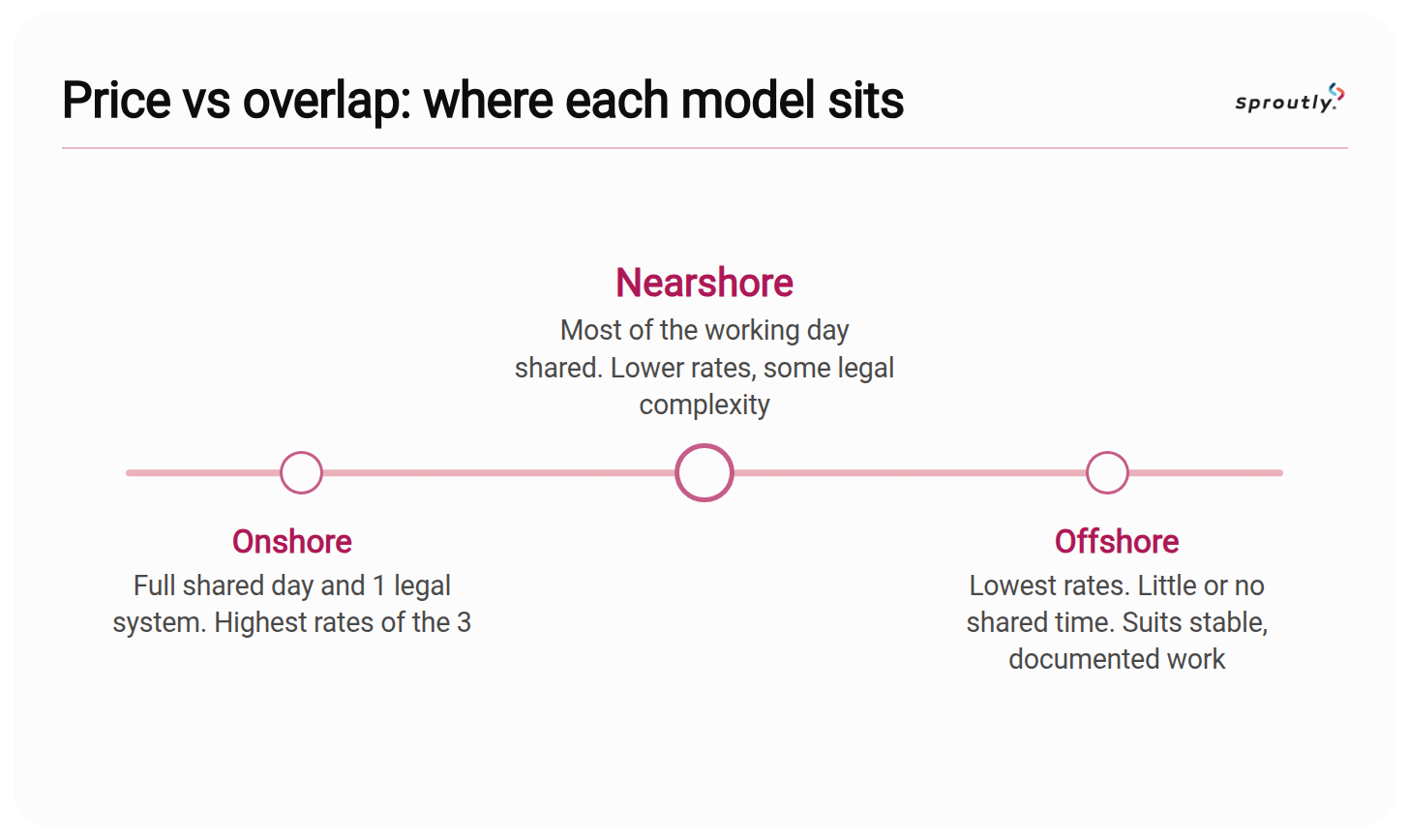
Onshore, nearshore, and offshore outsourcing describe where a vendor's team sits relative to the client. Onshore means the same country. Nearshore means a nearby country that shares most of the working day, typically 0 to 3 hours apart. Offshore means a distant country with little or no shared working time. The same vendor can be nearshore for one client and offshore for another.
What is onshore outsourcing?
Onshore outsourcing means hiring a vendor in your own country: a startup in Virginia working with an agency in Austin, for example. You get a full shared day (the continental US spans only 3 hours), one legal system, and the highest rates of the three. In any onshore vs offshore comparison, onshore wins on overlap and legal simplicity and loses on price.
The budget version founders tend to forget: onshore vendors in smaller US cities, which keep the legal simplicity at a lower rate than big-city agencies.
What is nearshore outsourcing?
Nearshore outsourcing means hiring a vendor in a neighboring country or region, usually 0 to 3 hours from you, so most of the working day is shared. For US companies, the common nearshore locations are Mexico, Colombia, Argentina, Brazil, and Costa Rica.
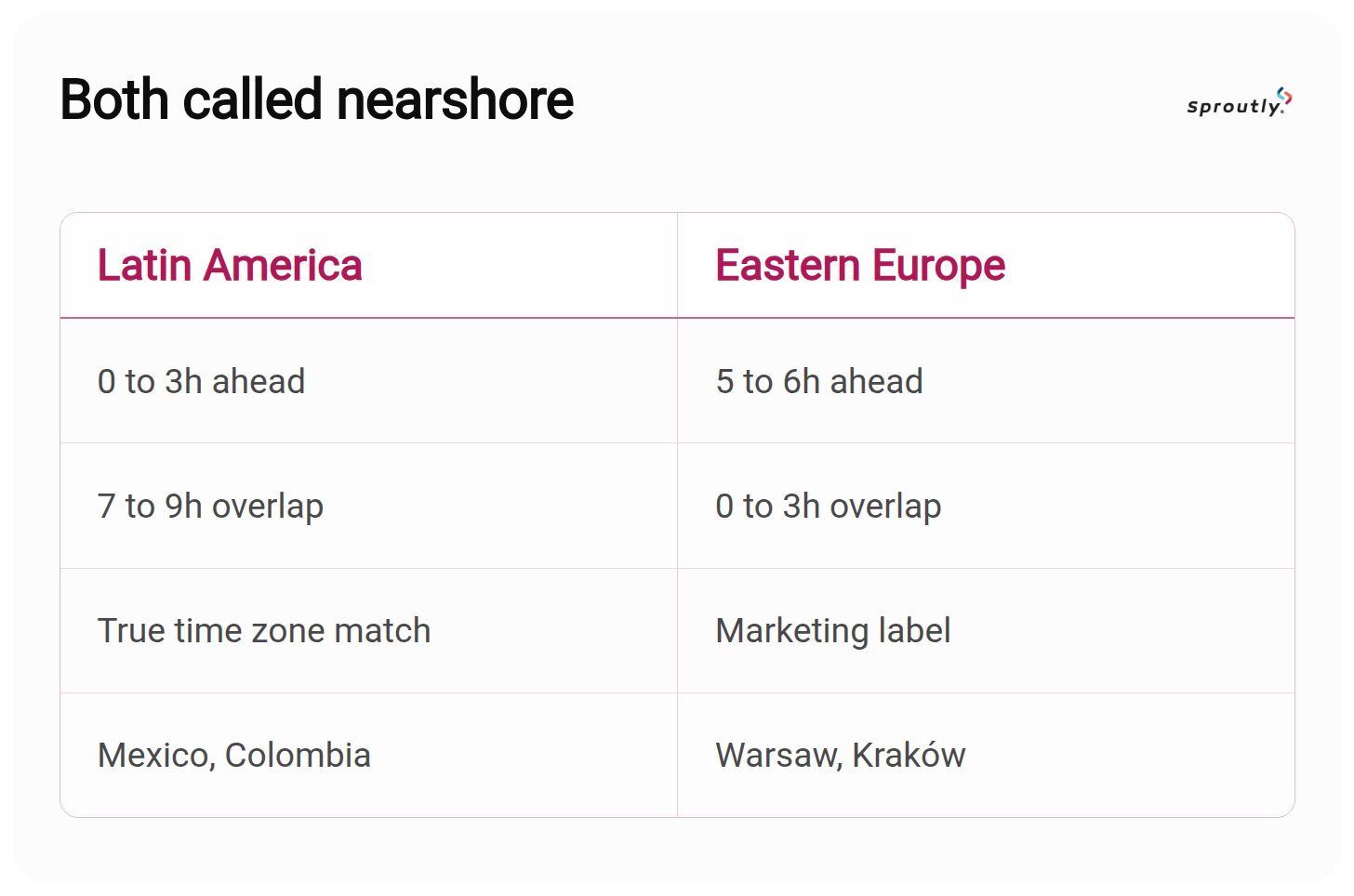
Many Eastern European vendors also market themselves to US clients as nearshore. By distance, they are not: Warsaw is 6 hours ahead of New York. That can still work, as the overlap section shows, but it is a different arrangement from a team in Mexico City.
What is offshore outsourcing?
Offshore outsourcing means hiring a vendor in a distant country, usually 5 or more hours away, where shared working time is short or zero. India, the Philippines, and Vietnam are the usual offshore software development locations for US companies, and they have the lowest rates on average. For a West Coast startup, Eastern Europe is offshore too.
A note on terms people mix up
- Offshoring vs offshore outsourcing. Offshoring means moving work abroad, which can include opening your own office there. Offshore outsourcing means hiring a vendor abroad to do the work.
- Reshoring vs onshore outsourcing. Reshoring (sometimes called onshoring) means bringing work back home, to your own staff or a domestic vendor. Onshore outsourcing is one way to do it.
- Hybrid, rightshoring, and bestshoring. All three mean mixing locations on one project; the last two are marketing labels for the same idea. If a vendor uses them, ask which work goes where.
Onshore vs nearshore vs offshore: side-by-side comparison
Onshore vs nearshore vs offshore outsourcing differs most on working-hour overlap and rates. For a US client, onshore and nearshore teams typically share 4 to 9 hours of a standard working day; offshore teams share between 0 and 3. Asian senior rates run roughly half of Latin American and Eastern European ones, according to Accelerance's 2026 data.
Onshore vs offshore vs nearshore at a glance, for a US client (overlap assumes a 9am to 6pm working day at both ends)
|
Onshore (US) |
Nearshore (Latin America) |
Offshore |
|
|
Typical time difference |
0 to 3 hours |
0 to 5 hours |
6 hours or more |
|
Time zone overlap (shared hours) |
6 to 9 hours |
4 to 9 hours |
0 to 3 hours |
|
Senior engineer rate (2026) |
Highest. For reference, the US median developer salary is $135,980 a year before any vendor overhead |
$60 to $75/h |
$31 to $41/h (Asia); $64 to $76/h (Eastern Europe) |
|
Travel for an in-person kickoff |
Same-day domestic flight |
Roughly 3 to 11 hours, often direct |
10 to 20 hours, often with a connection |
|
Legal and data friction |
Lowest: one jurisdiction |
Moderate: foreign contracts, IP assignment to check |
Highest variance: IP assignment, data rules such as the DOJ Data Security Program |
|
Best fit |
Regulated work, products that need frequent in-person contact |
MVPs and products where decisions happen daily |
Stable, well-specified work; QA and support at volume |
|
Main risk |
Cost |
Vendors calling themselves nearshore when they are not near you |
Slow feedback loops and overnight waits |
Rates: Accelerance, 2026 Software Development Outsourcing Rates (November 2025). Salary: US Bureau of Labor Statistics, May 2025.
For most startups, 2 rows decide the choice: overlap and fully loaded cost. Culture gets a lot of airtime in sales calls, and for engineering work it matters less than the pitch suggests. Clear specs, a shared checklist for "done," and a few hours of live time each day close most of that gap.
Why "nearshore" depends on where you sit
Whether a vendor counts as nearshore depends on where the client sits. A Warsaw team shares 3 hours of a 9-to-6 day with New York and none with San Francisco. A Mexico City team shares 7 to 9 hours with all 3 US time zones. Time zone overlap, measured in shared working hours, is the number worth comparing across vendors.
A 6-hour time difference still leaves 3 shared hours. A 9-hour difference leaves none. Here is the overlap from 3 US cities.
Shared hours in a 9am to 6pm day (time difference in brackets, summer/winter; + means the delivery hub is ahead of you)
|
From your city |
Mexico City |
Bogotá |
Buenos Aires |
Warsaw |
Pune (India) |
Manila |
|
New York |
7 to 8h (−2h/−1h) |
8 to 9h (−1h/0h) |
7 to 8h (+1h/+2h) |
3h (+6h) |
0h (+9.5h/+10.5h) |
0h (+12h/+13h) |
|
Chicago |
8 to 9h (−1h/0h) |
8 to 9h (0h/+1h) |
6 to 7h (+2h/+3h) |
2h (+7h) |
0h (+10.5h/+11.5h) |
0h (+13h/+14h) |
|
San Francisco |
7 to 8h (+1h/+2h) |
6 to 7h (+2h/+3h) |
4 to 5h (+4h/+5h) |
0h (+9h) |
0h (+12.5h/+13.5h) |
0 to 1h (+15h/+16h) |
Two seasonal quirks move these numbers. Mexico City, Bogotá, Buenos Aires, Pune, and Manila do not change their clocks, so their gap with US cities shifts by an hour twice a year. And the US and Europe switch to summer time on different dates: for about 3 weeks in March and 1 week around the start of November, the New York to Warsaw gap drops to 5 hours, and recurring meetings drift by an hour for one side.
What the hours mean in meetings
With a 9-to-6 Warsaw day, a New York team gets roughly 9am to noon together. That window fits a standup (the daily 15-minute check-in), a sprint demo, and one round of code review. A bug that shows up at 2pm in New York lands after Warsaw has logged off, so it waits until morning unless someone agreed to cover it.
With Mexico City or Bogotá, the whole day overlaps. A question asked at 4pm gets answered at 4:10.
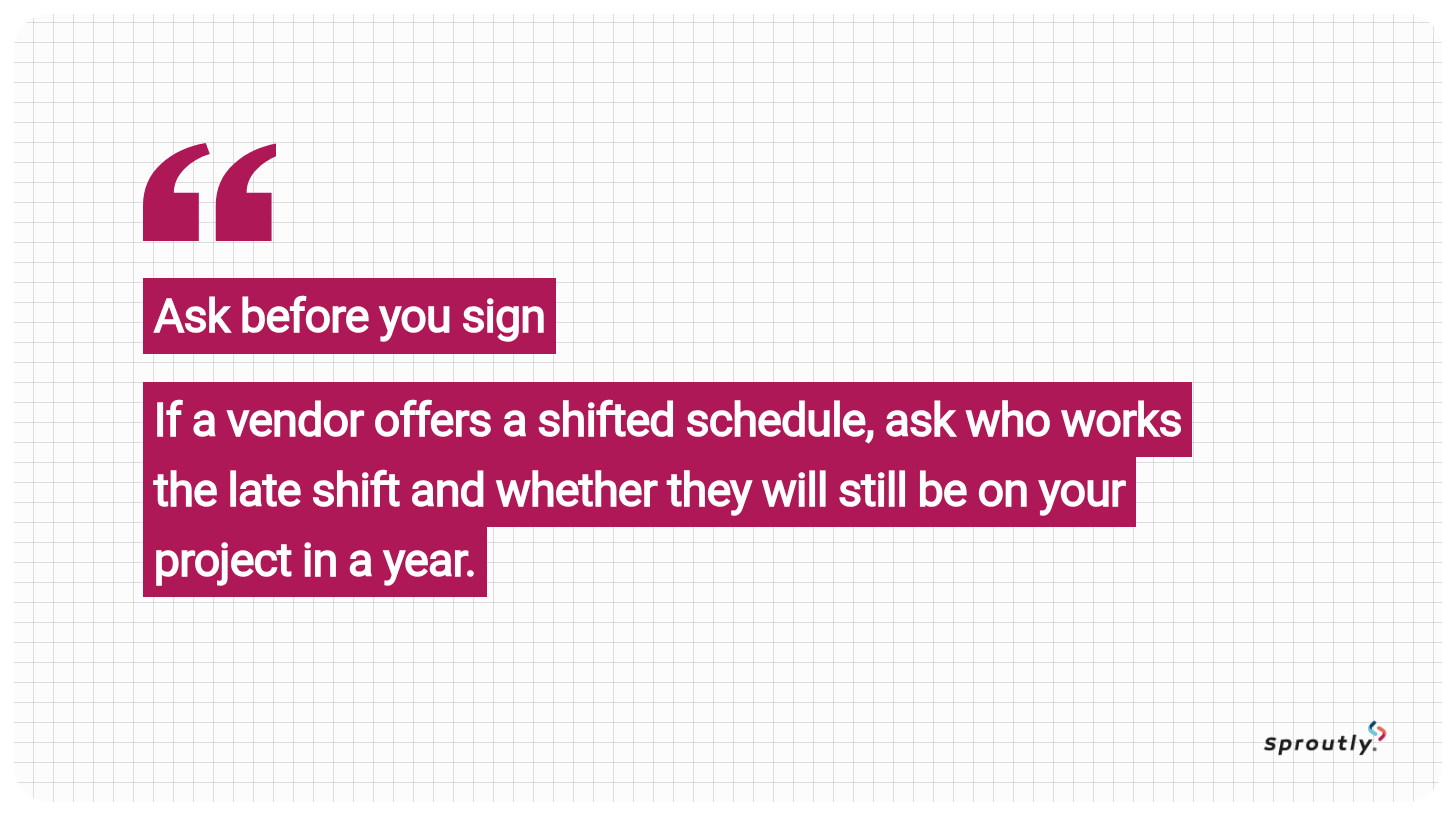
With Pune, there is no shared hour in a standard day. Many Indian vendors solve this with a shifted schedule. A team working 1pm to 10pm Pune time gives New York roughly 2.5 to 3.5 morning hours, depending on the season, and a San Francisco team almost none. Ask who works the late shift, and whether they will still be on your project in a year.
So nearshore vs offshore is a question you can answer only from your own city. A vendor list that sorts countries into buckets without knowing where you are is guessing.
Where Sproutly sits
Sproutly works with teams in all 3 models, and our offshore partners include teams in Pune, India. So we see both sides of the offshore math: the rate advantage is real, and so is the overnight wait for an answer.
Our model pairs the development team with a US-based Edge Facilitator on your side of the time zone, who handles questions, reviews, and status during your working day.
What each model really costs
Rates differ sharply by region, and hourly rates understate the cost of distance. Accelerance's 2026 data puts senior rates at $60 to $75 an hour in Latin America, $64 to $76 in Central and Eastern Europe, and $31 to $41 in Asia. Coordination, ramp-up, and rework sit on top of those numbers and grow with distance.
Hourly rates by region
|
Region |
Junior rate |
Senior rate |
Change year on year |
|
Latin America |
$33 to $45/h |
$60 to $75/h |
−7.1% |
|
Central and Eastern Europe |
$31 to $39/h |
$64 to $76/h |
−4.4% |
|
Asia |
$24 to $31/h |
$31 to $41/h |
about −8% |
|
US reference (salary, not a vendor rate) |
Median $135,980 a year |
Sources: Accelerance, 2026 Software Development Outsourcing Rates (November 2025); US Bureau of Labor Statistics, Occupational Outlook Handbook (May 2025 wage data).
If you are weighing Latin America against Eastern Europe, price barely separates the two. The senior ranges overlap almost completely, and Latin America gives a US team far more shared hours. Asia is the real price break, at roughly half the senior rate, with the overlap trade-off from the previous section.
The US line needs a caveat: a salary and a vendor rate are different units. Divide $135,980 by a 2,080-hour year and you get about $65 an hour, which makes hiring in-house look cheaper than it is, because a vendor rate also covers benefits, overhead, time between projects, and margin. In any nearshore vs offshore vs onshore cost comparison, keep salaries and vendor rates in separate columns.
The cost the rate card leaves out
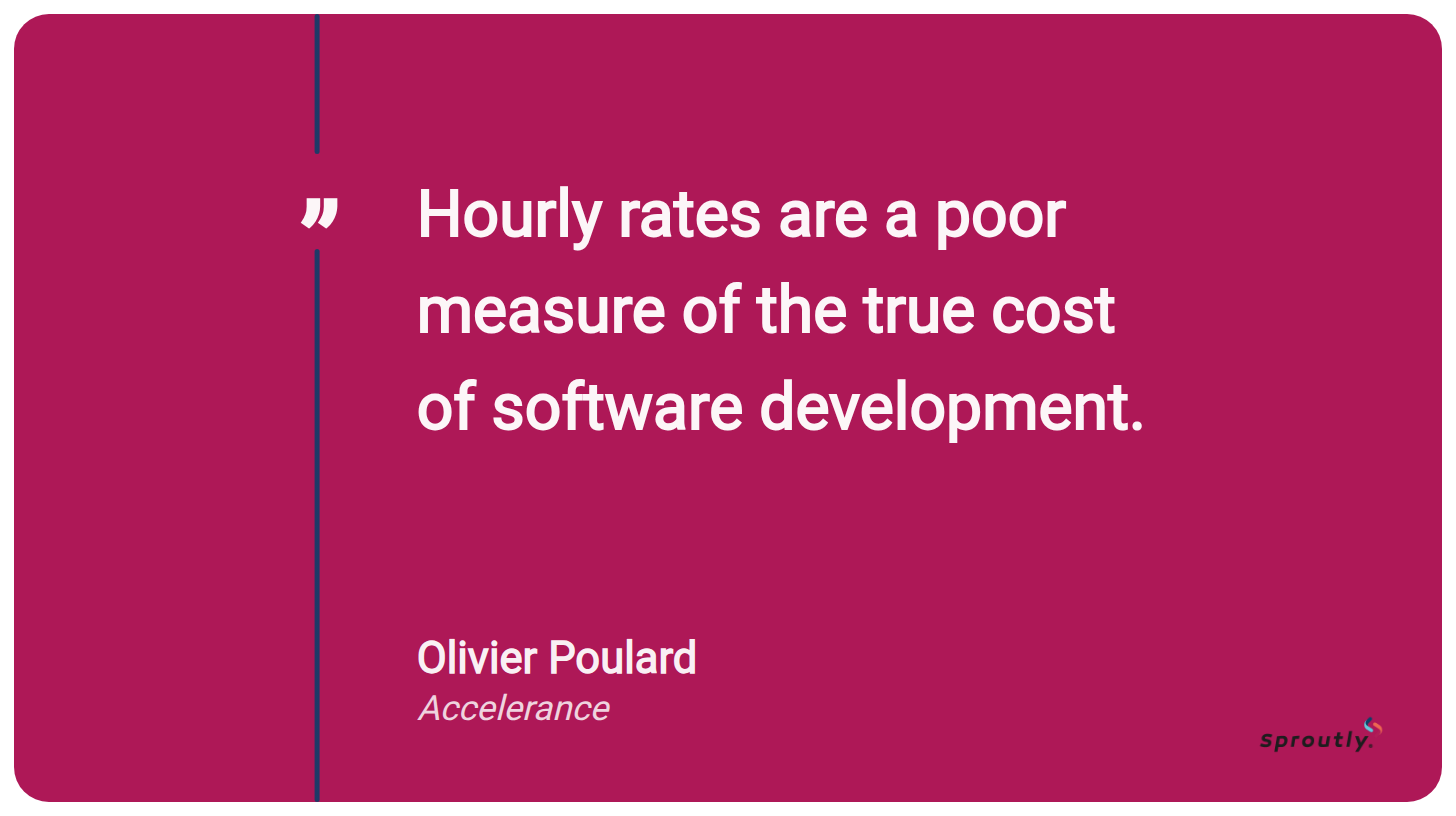
The biggest missing line is coordination. James Herbsleb and Audris Mockus studied two multi-site software organizations and found that distributed work items took about 2.5 times as long to complete as similar items done at one site (IEEE Transactions on Software Engineering, 2003). The delay came from headcount: distributed items pulled in more people, and the number of people involved tracked closely with how long the work took. Tooling has improved since 2003. More people and more waiting per decision is still what a time zone gap produces.
Accelerance makes the same point from the vendor side. As Olivier Poulard, its Managing Director of Global Software Engineering Strategies, puts it: "Hourly rates are a poor measure of the true cost of software development."
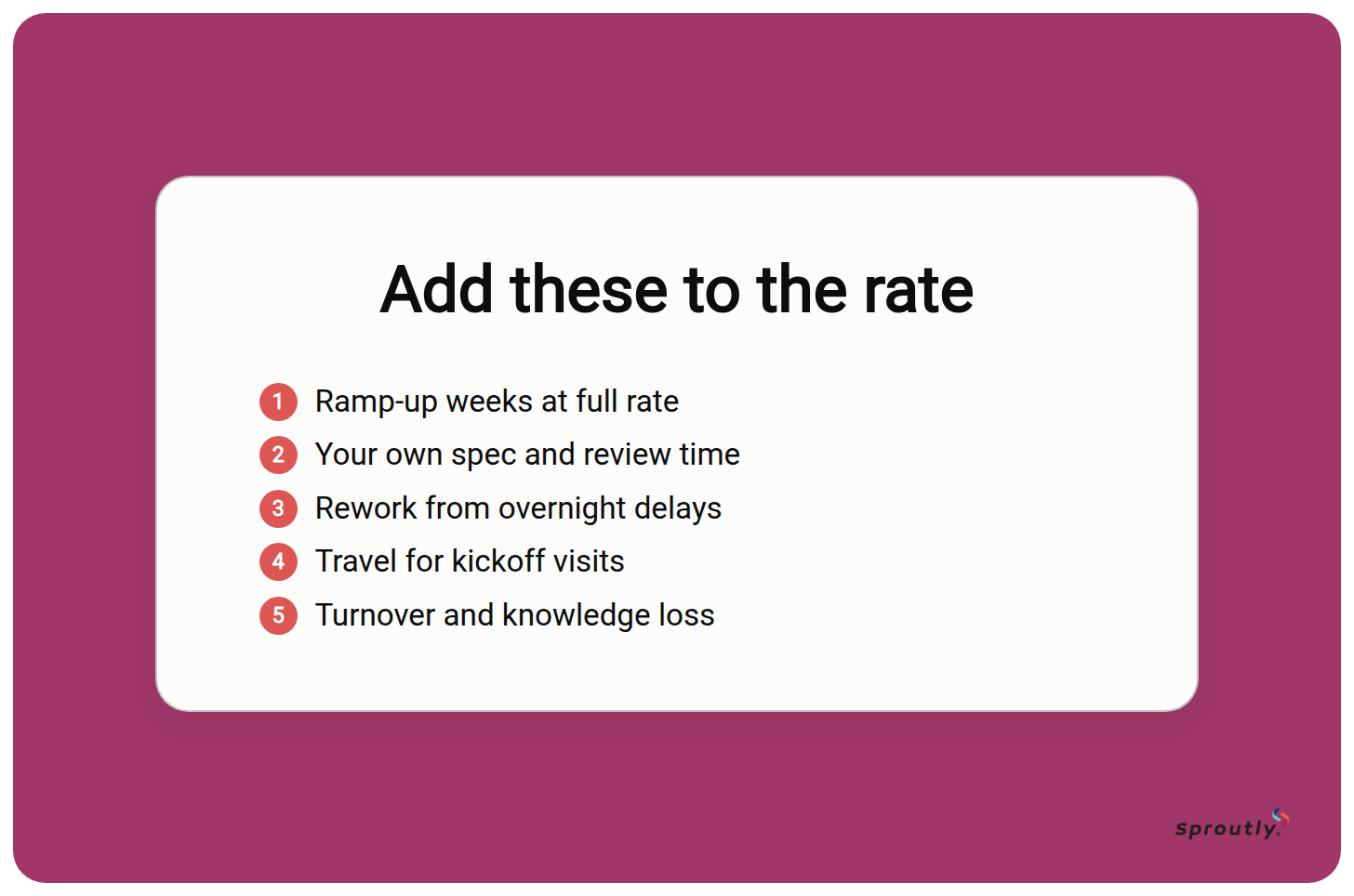
Before you compare proposals, add these to the rate:
- Ramp-up time. New developers need weeks before they ship at full speed, and you pay the full rate for those weeks.
- Your own time. Someone on your side writes specs, answers questions, and checks the work. With less overlap, more of it happens in writing, which takes longer.
- Rework from unclear requirements. A misunderstanding that a 5-minute call would fix becomes a lost day when the answer arrives overnight.
- Travel. A kickoff visit costs more when the flight is 15 hours.
- Turnover. A replacement developer restarts ramp-up, and some product knowledge leaves with the person.
A quick way to frame it for your budget: a 4-person senior team for 6 months, at about 900 billable hours each and midpoint rates, costs roughly $252,000 in Eastern Europe, $243,000 in Latin America, and $130,000 in Asia. That $113,000 to $122,000 gap is real money for a startup. The question is whether the extra coordination on your specific product costs more or less than that. For stable, documented work, it usually costs less. For an MVP where decisions change weekly, it often costs more.
Compliance and data: the filter before price
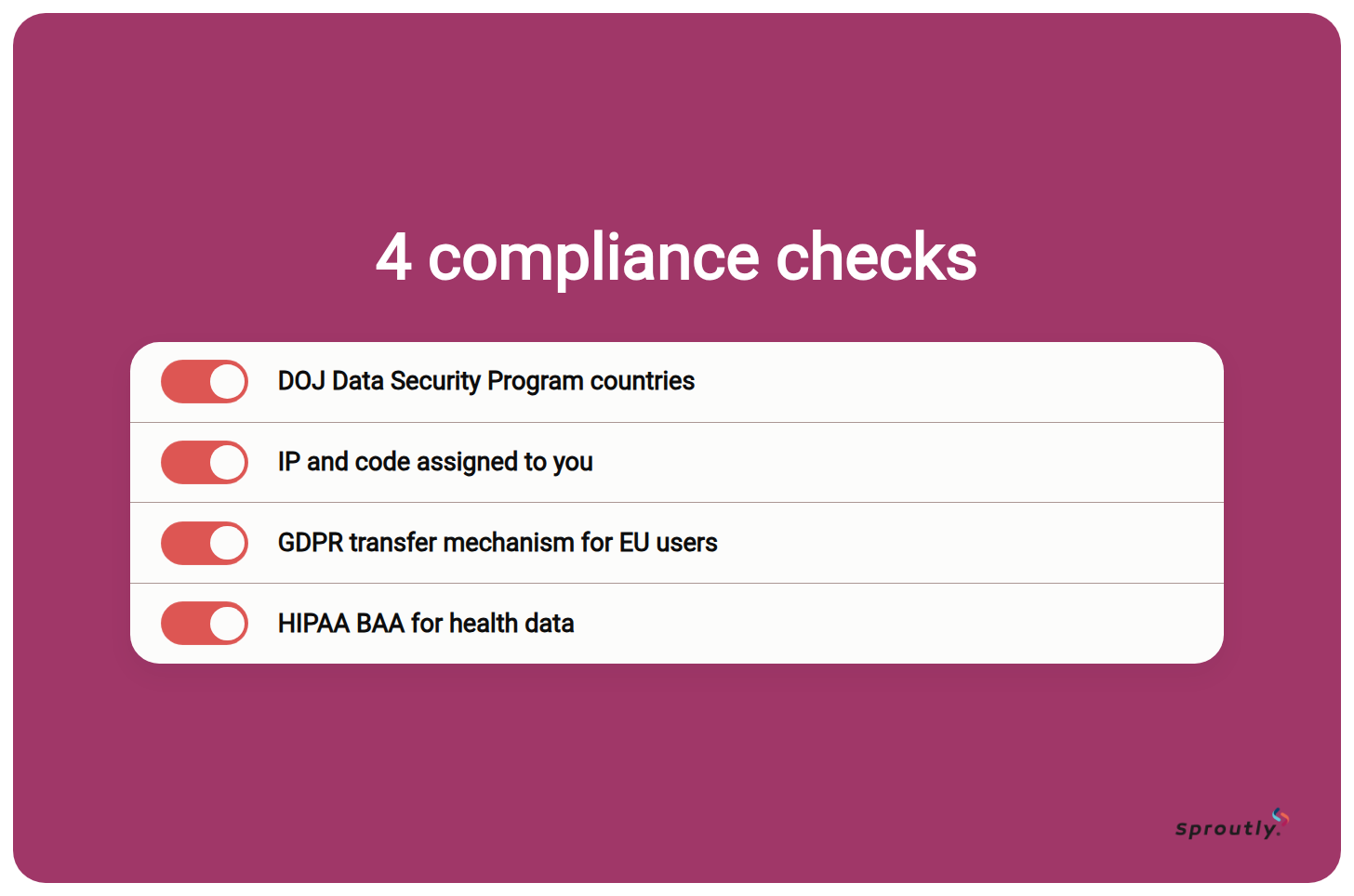
Some rules remove countries from a shortlist before price is discussed. US companies holding bulk sensitive personal data, such as health or financial data on more than 10,000 Americans, face the DOJ Data Security Program. Every outsourced build also needs a contract that assigns the code and IP to you, which gets harder to enforce across borders.
Three checks cover most startups.
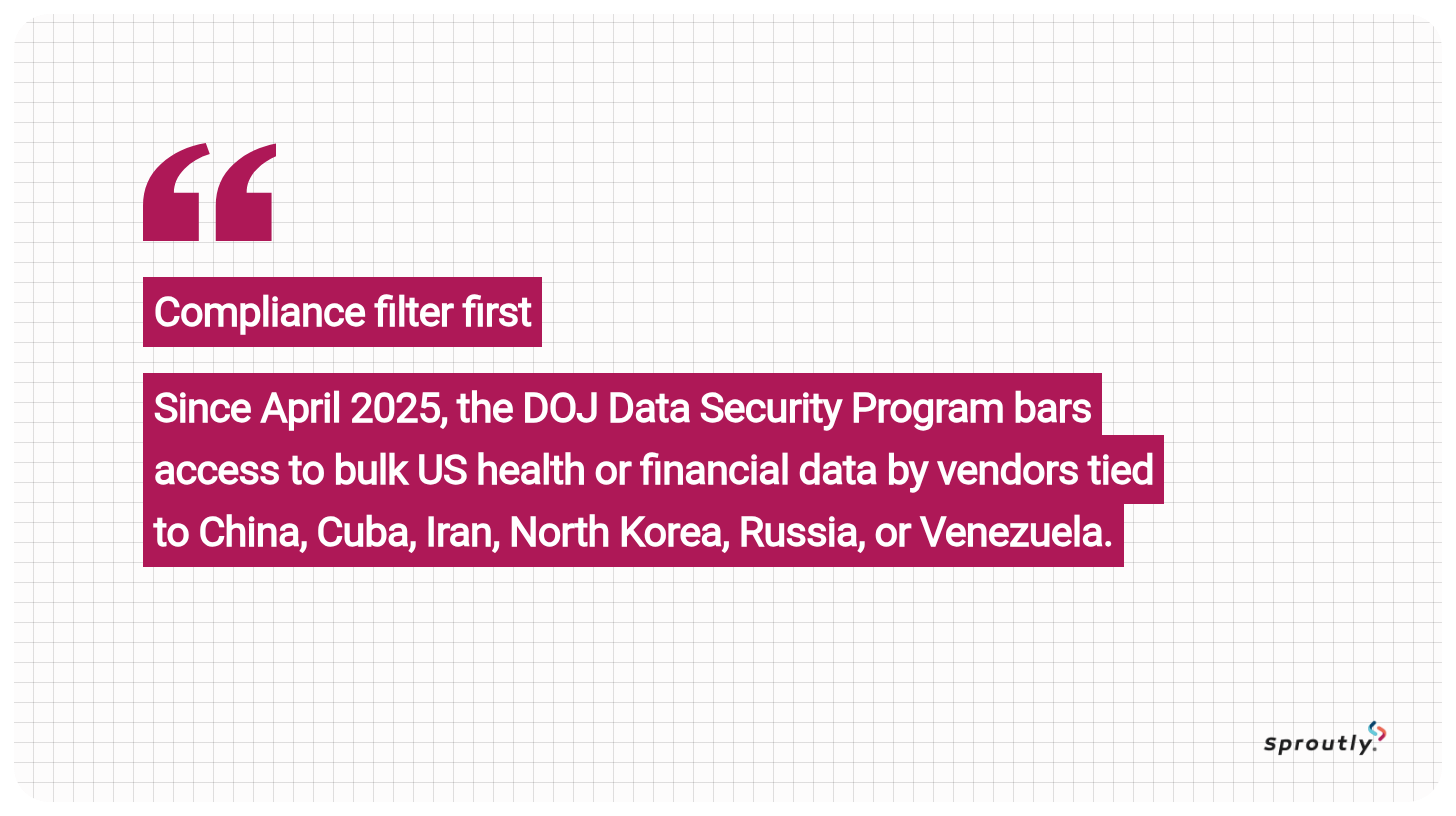
Sensitive personal data. Since April 8, 2025, the DOJ Data Security Program (28 CFR Part 202) has restricted US companies from giving countries of concern, or people and entities tied to them, access to bulk US sensitive personal data. The countries are China (including Hong Kong and Macau), Cuba, Iran, North Korea, Russia, and Venezuela. "Bulk" starts low: more than 10,000 US persons for health or financial data, 1,000 for precise geolocation or biometric data, and 100 for genomic data, counted over 12 months. Vendor and employment agreements that give such access are allowed only with CISA's security requirements in place. If your product could reach those numbers, ask every vendor where developers with data access are located, who owns the company, and whether any subcontractor sits in a country of concern.
Code and IP ownership. Make sure the contract assigns all code and IP to your company, and that the vendor's own contracts with its developers do the same. Investors check this during due diligence, and it is harder to fix after the fact when the developer sits in another country. Owner access to your code repository and hosting accounts from day 1 is part of the same protection. Our article on signs your dev team is behind lists every account you should own.
EU customers. If your product holds personal data on people in the EU, GDPR follows that data. Sending it to a team in India or most of Latin America needs a transfer mechanism, typically standard contractual clauses, unless an EU adequacy decision covers the country. Argentina has one, and Brazil has had one since January 2026.
If you are building a health product, add HIPAA to the list: an offshore vendor that handles patient data needs a business associate agreement, the same as a US one.
This section is orientation, not legal advice. Confirm the rules that apply to your data with a lawyer.
Location vs engagement model: two separate decisions
Location and engagement model are two separate decisions. Freelancers, staff augmentation, dedicated teams, and fixed-scope projects can each run onshore, nearshore, or offshore. Location decides overlap, cost, and legal exposure. The engagement model decides who manages the developers and who owns the outcome.
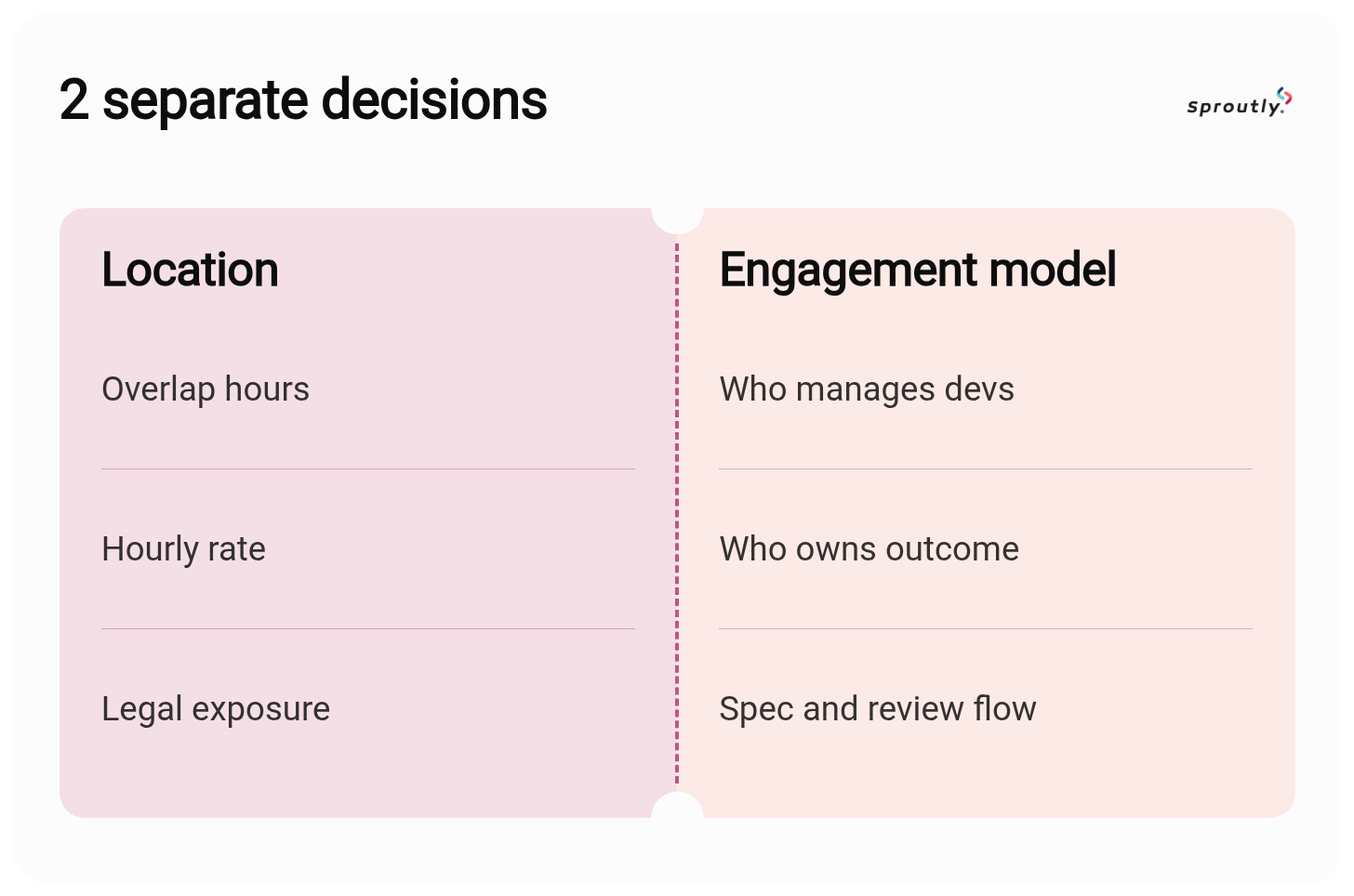
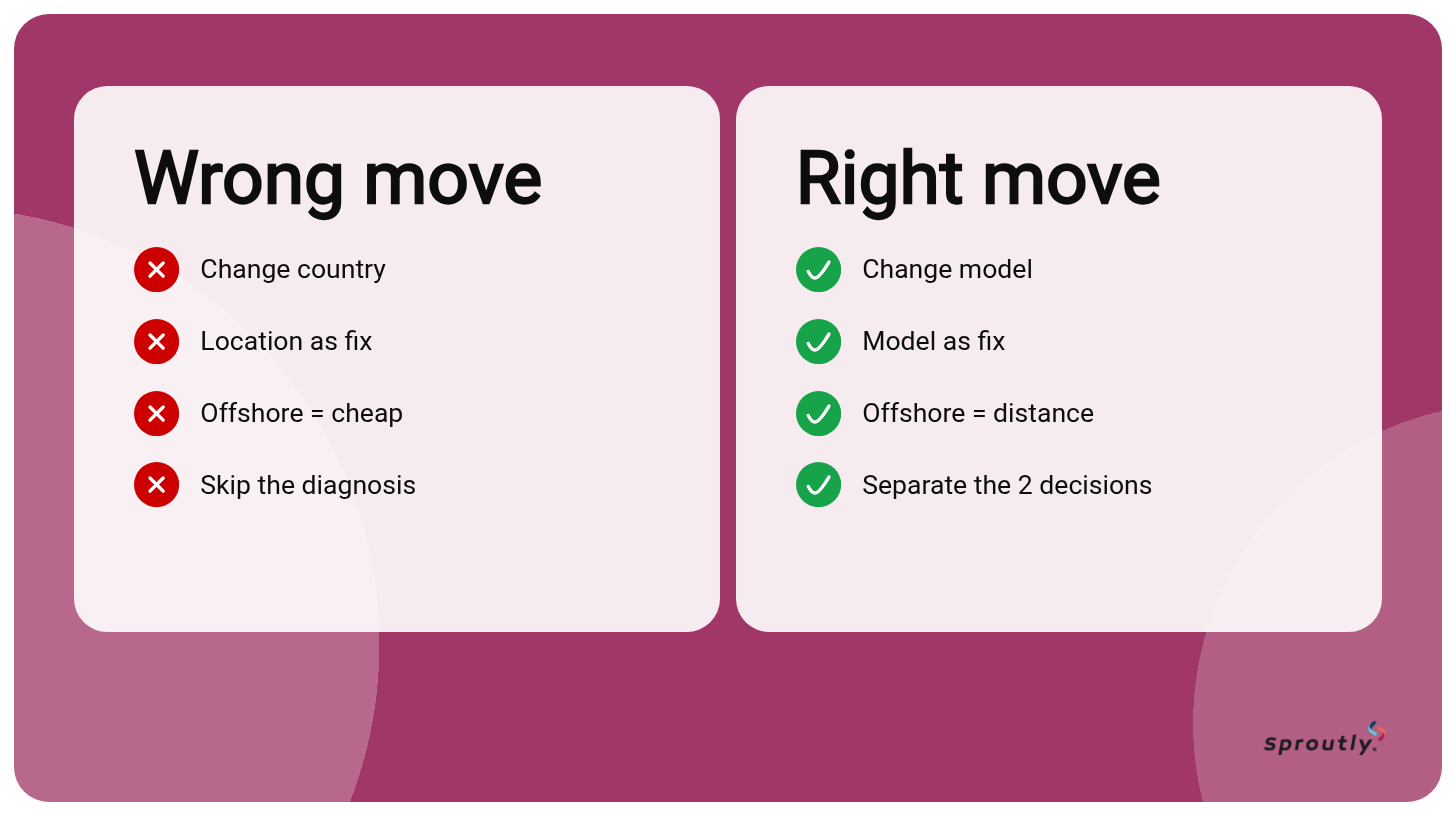
"Offshore" often gets used as shorthand for cheap freelancers. Founders who think that way end up changing countries when the real problem was the model, or the reverse. Location changes each model in a specific way:
- Freelancers and staff augmentation. Individual developers take direction from you or your technical lead all day. This model needs the most overlap, and it only works offshore if someone on your side can review code and write detailed specs.
- Dedicated team. A standing team, with its own lead, that works only on your product and makes daily decisions with you. It needs a reliable overlap window, which pushes the choice toward onshore or nearshore, or toward an offshore team with a shifted schedule.
- Fixed-scope project. A well-specified build with clear acceptance criteria tolerates distance best, because most questions get answered before work starts. Most MVPs are not this well specified, so be honest about which one you have.
The hybrid model: which work goes where
A hybrid outsourcing model splits one project across locations by type of work. Decisions that need the business to stay close, the core build sits where overlap is good or where a local lead can cover the gap, and stable, well-documented work goes where rates are lowest. Follow-the-sun works for support; for feature development, every handoff adds coordination cost.
A split that holds up for a startup looks like this:
|
Where |
What goes there |
Why |
|
Onshore (you, or a US-based technical lead) |
Product decisions, priorities, acceptance, oversight of the vendor |
These need the business in the room, often the same day |
|
Nearshore, or offshore with a local lead |
Core feature development, code review |
Daily collaboration with whoever owns the product |
|
Offshore |
Regression testing, support tickets, well-specified maintenance |
Stable, documented work that survives an overnight handoff |
Follow-the-sun development deserves an honest look. It works for support: a ticket queue can pass from Manila to New York with a written handoff, and customers get round-the-clock cover. For feature work it rarely holds up, because every handoff is a moment where the next team waits on a question only the previous team can answer. That is the Herbsleb and Mockus effect, twice a day.
A useful rule for a hybrid outsourcing model: keep each feature team inside one overlap zone, and let only well-documented work cross the widest gaps.
Does AI change the location decision?
AI coding tools are now common in outsourced work: Deloitte's 2024 Global Outsourcing Survey found 83% of executives use AI as part of their outsourced services. The tools shorten the time spent writing code, which leaves a larger share of each week for decisions, reviews, and clarifications. That shift makes working-hour overlap count for more.
Our view at Sproutly: when code takes less time to write, a bigger share of the job is deciding what to build, checking what the tools produced, and clearing up requirements. Those are the parts that need someone on your side awake at the same time. A team that ships a feature in 2 days and then waits a day for your answer has given half its speed back.

How to choose: a decision framework
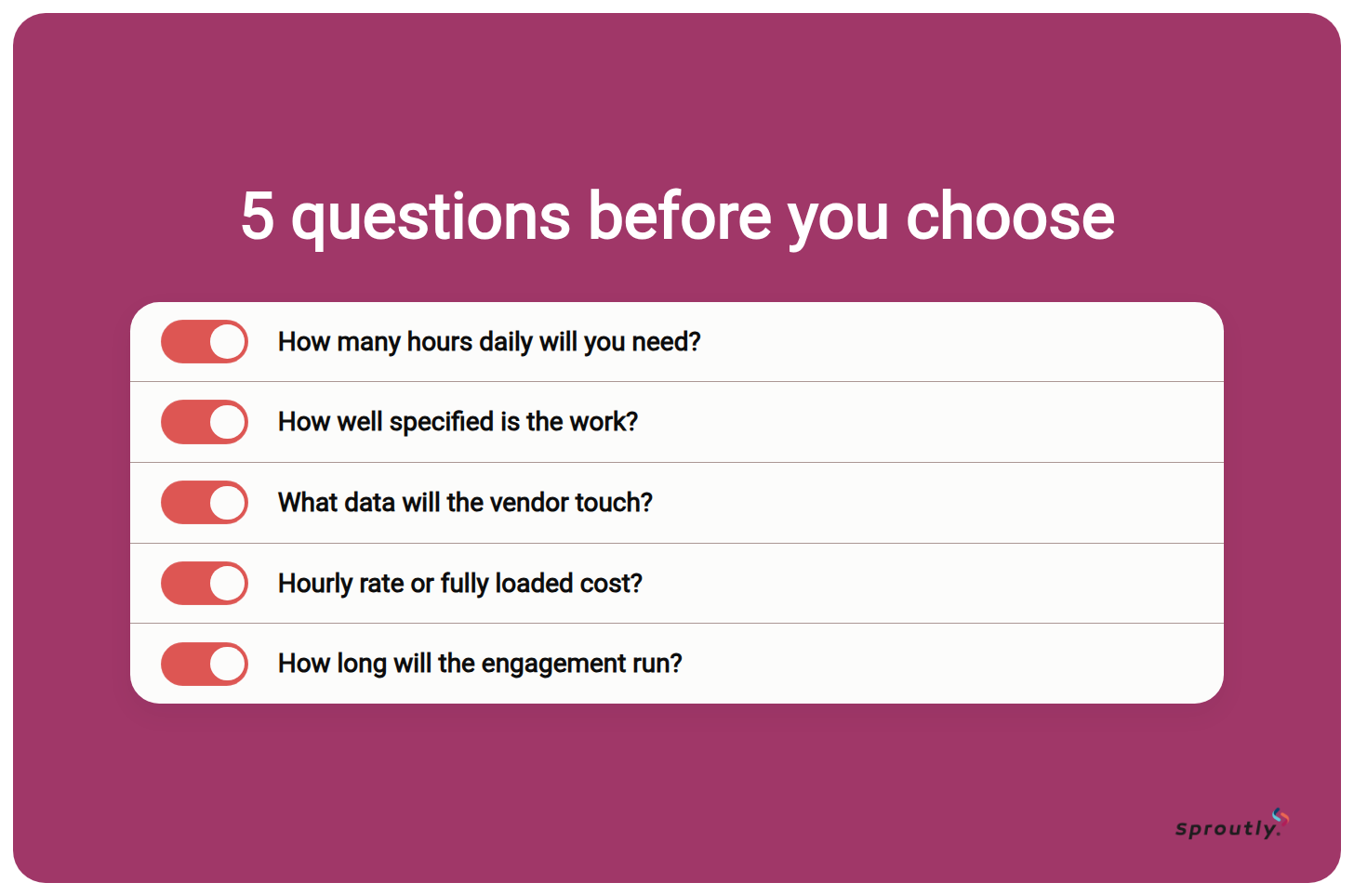
Choosing between onshore, nearshore, and offshore comes down to 5 questions: how much live collaboration the work needs, how well specified it is, what data the vendor will touch, what the full cost is over the engagement, and how long the engagement runs. The answers usually narrow the field to 1 or 2 locations.
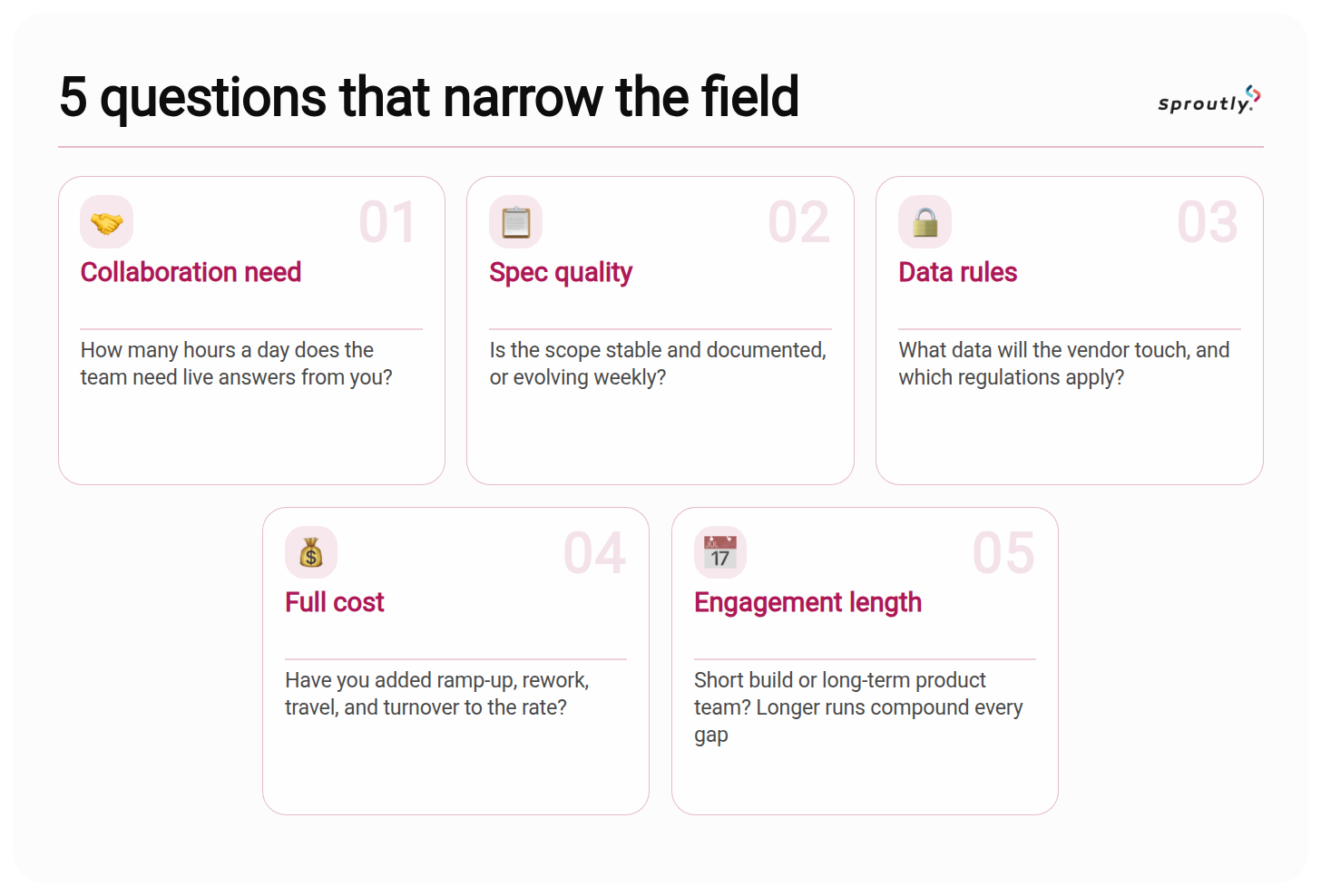
- Who on your side answers the team's questions, and how many hours a day will they need you? If the team needs daily decisions from you, shortlist vendors with at least 3 to 4 hours of time zone overlap from your city (see the table above), or plan for a technical lead who covers the gap. If a weekly check-in is enough, offshore stays on the table.
- How well specified is the work? An MVP with evolving scope favors overlap. A stable, documented scope tolerates distance.
- What data will the vendor touch, and which rules apply to it? Health or financial data at scale: rule out any vendor with exposure to a country of concern first. EU users: budget time for transfer paperwork. Any build: confirm IP assignment and owner access before work starts.
- Are you comparing hourly rates or fully loaded cost? Add ramp-up, your own time, rework, travel, and turnover over the life of the engagement, then compare.
- How long will this run? A 3-month build tolerates distance and favors low setup cost. A 3-year product team compounds every hour of overlap and every developer who stays.
Wrapping up
Onshore buys you a full shared day and legal simplicity at the highest price. Nearshore trades some of that price for most of the working day, as long as the vendor is near you. Offshore gives the lowest rates and suits work stable enough to survive distance, or a setup where someone local covers the gap. The answer to onshore vs nearshore vs offshore starts with your city, your data, and your product, and the rate card comes after.
How Sproutly helps
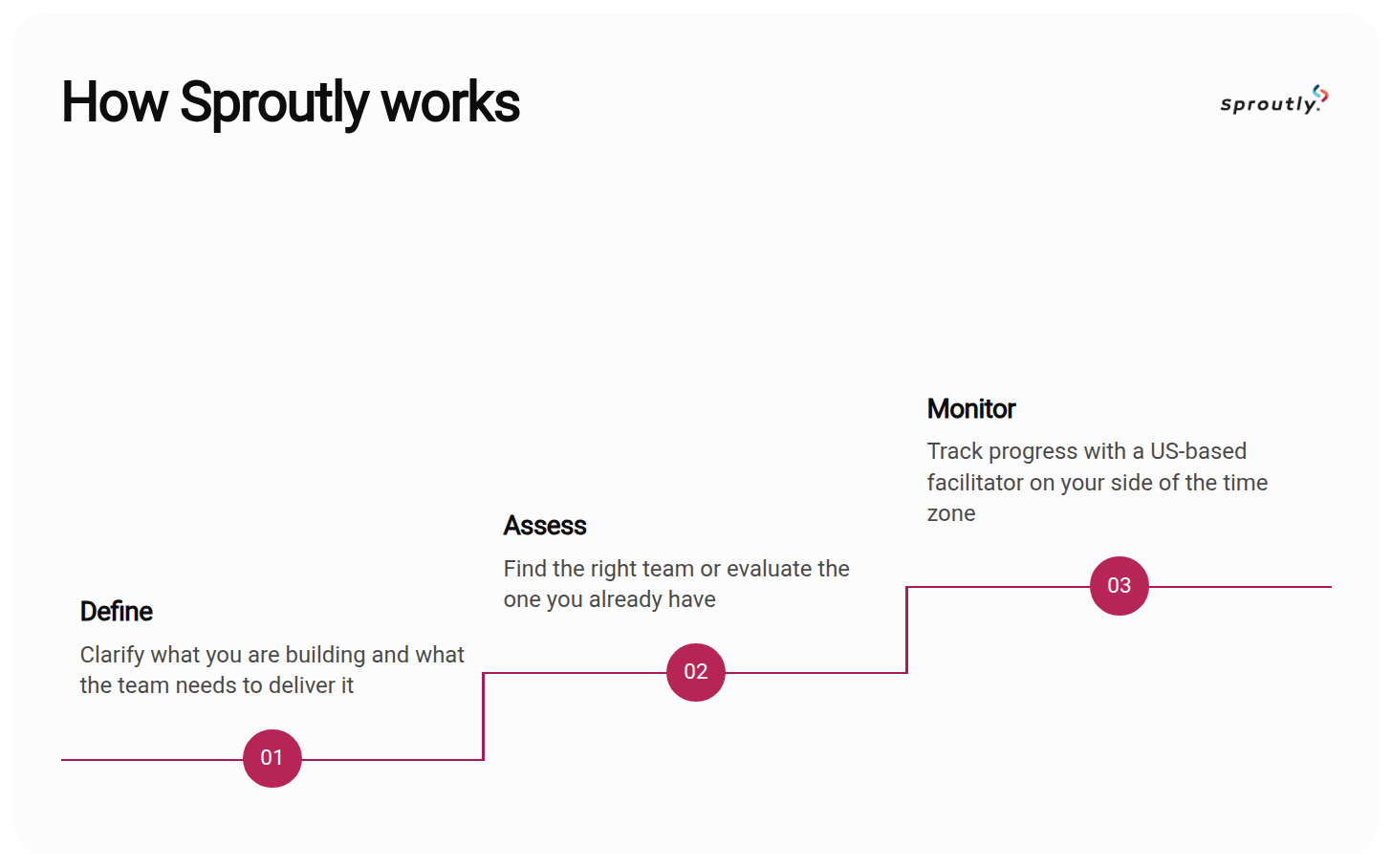
Sproutly works with startups and small businesses that build software with outsourced teams. Our model has 3 steps: define, assess, and monitor.
We help you define what you are building, find a team (onshore, nearshore, or offshore) or assess the one you have, and monitor progress, with a US-based facilitator on your side of the time zone. Since 2017, we have helped founders ship products in healthcare, telecom, education, and transportation, including an MVP we took over from a previous developer.
Still choosing where your team should sit? Book a needs assessment and we will map your product, data, and budget against the options. Already working with a team and unsure about the overlap? Schedule a team assessment.
You can also meet the team behind Sproutly.
References
- Accelerance (2025). 2026 Software Development Outsourcing Rates: Asia, Europe, and LatAm. November 24, 2025. Accelerance
- US Bureau of Labor Statistics. Occupational Outlook Handbook: Software Developers, Quality Assurance Analysts, and Testers. May 2025 wage data. BLS
- Herbsleb, J. D., and Mockus, A. (2003). "An Empirical Study of Speed and Communication in Globally Distributed Software Development." IEEE Transactions on Software Engineering, 29(6). PDF
- Deloitte (2024). 2024 Global Outsourcing Survey. Deloitte
- 28 CFR Part 202: Access to US Sensitive Personal Data and Government-Related Data by Countries of Concern or Covered Persons. Electronic Code of Federal Regulations. eCFR
- Davis Polk (2025). "DOJ releases guidance on Data Security Program." Davis Polk
- European Commission (2026). "EU-Brazil data adequacy agreement." European Commission
- timeanddate.com. Time zone and daylight saving data for all cities in the overlap table. timeanddate.com
FAQ
What is the difference between onshore, nearshore, and offshore outsourcing?
In offshore vs nearshore vs onshore outsourcing, the difference is distance from you and the working hours you share. Onshore vendors are in your country. Nearshore vendors are in a nearby country, usually 0 to 3 hours away, with most of the day shared. Offshore vendors are far away, usually 6 or more hours for a US company, with little or no shared time.
Is nearshore cheaper than offshore?
No. On average, offshore rates are lower. Accelerance's 2026 data puts senior rates at $31 to $41 an hour in Asia, compared with $60 to $75 in Latin America. Nearshore trades part of that price gap for more shared working hours, which cuts coordination cost on work that needs frequent decisions.
Which countries are nearshore for US companies?
Mexico, Colombia, Argentina, Brazil, and Costa Rica are the usual nearshore countries for US companies. Check the actual overlap from your city: Bogotá shares 8 to 9 hours with New York and 6 to 7 with San Francisco.
Is Eastern Europe nearshore or offshore for a US company?
Offshore by distance, even though many Eastern European vendors market themselves as nearshore. New York gets a morning window of about 3 hours with Warsaw, Chicago about 2, and San Francisco none in a standard day.
Can offshore developers work US business hours?
Some do, usually on a shifted schedule such as 1pm to 10pm in India, which gives the US East Coast 2.5 to 3.5 morning hours. Ask how it is arranged: late shifts are hard to sustain, which can raise turnover, and full night coverage may cost more.
Is nearshore better for agile development?
For most agile teams, yes. Standups, sprint planning, demos, and quick back-and-forth on code reviews all need live time. A nearshore team with 6 or more shared hours can run those without anyone working odd hours. Offshore agile teams can work, but they need stronger written specs and a planned overlap window.
Can I combine onshore, nearshore, and offshore in one project?
Yes. The model holds up when you split by type of work: product decisions and oversight close to you, the core build where overlap is good or a local lead covers the gap, and stable, documented work offshore. See the hybrid section above for a sample split.
Do I need a technical person on my side if I outsource offshore?
It helps more offshore than anywhere else. With little shared time, questions arrive in writing and overnight, and someone has to answer them precisely, review the work, and spot problems early. That can be a technical cofounder, a fractional CTO, or an oversight partner like Sproutly.