
You ask 2 development firms to quote your app. The first proposal opens with a line item for 4 weeks and $12,000, and none of it is code. The second firm offers to start building next week. The second option looks cheaper and faster, so you ask that firm what they will build in the first sprint. They say they will build whatever is in your brief, and your brief is 2 paragraphs and the name of a competitor's app.
Those 4 weeks in the first proposal are a discovery phase in software development. Whether they are worth the money depends on what you already have, and on what you hold in your hands when they end.
A good discovery phase leaves you with 7 documents that another team could quote from, and how many of them you need depends on what you bring to the first meeting. The decision table below shows which case is yours, and 6 questions at the end let you test any discovery proposal before you pay.
A discovery phase in software development is a short, fixed-scope stage before the build, usually 2 to 6 weeks, where you and the development team agree on what to build first and why. It ends with documents you keep: a written scope, a prioritized feature list, wireframes or a prototype, a technical plan, and an estimate.
What is a discovery phase in software development?
A discovery phase sits between "I have an idea" and "the team starts writing code." It is usually sold as a fixed-price engagement, and it ends with written answers to 4 questions:
- What must version 1 prove? The 1 or 2 things you need to learn from real users, such as whether clinics will book appointments through an app instead of by phone.
- What is in version 1, and what waits? A feature list split into "now" and "later," so the first build stays small enough to finish.
- How will it be built? The technology, the systems it must connect to, and the riskiest technical piece, tested before anyone commits to it.
- What will it cost, and how long will it take? An estimate with its assumptions written down, so you can see what would change it.
Version 1 is usually an MVP (minimum viable product): the smallest version of the product that tests your main assumption with real users. If you cannot yet say what yours must prove, start with how to decide what your MVP must prove .
You will also see this stage called a scoping phase, an inception phase, or Sprint 0. They describe the same work. It is also the first step in [how to outsource app development](LINK: Nov 5 pillar, confirm slug).
Discovery phase vs product discovery
Search results often mix up "discovery phase" and "product discovery," and they mean different things.
Product discovery is an ongoing practice inside a product team: talking to customers and testing ideas every week, before and after launch. Marty Cagan of Silicon Valley Product Group popularized the term in Inspired , and Teresa Torres describes the weekly habit in Continuous Discovery Habits (2021).
A discovery phase in software product development, the subject of this guide, happens once, before the build, and has an end date. Product discovery keeps going for as long as the product is live.
Why the discovery phase matters before you build
The importance of a project discovery phase in software development comes down to cost. Changing a decision in a document takes an afternoon, and changing it in working code can take a sprint.
The most expensive mistakes are decisions about what to build. CB Insights looked at 431 venture-backed startups that shut down since 2023 and found reasons for 385 of them. 43% cited poor product-market fit.
Running out of money came first, at 70%, though the report treats it as the last step toward closing more than the root problem. Companies could name more than 1 reason, so the shares add up to more than 100%.
A discovery phase tests your riskiest assumption with target users before you pay a team to build around it. Whether the product finds its market is still decided after launch, by paying customers.
The scope is what you will be billed against. Without a written scope, every quote is a guess, and every change becomes a new invoice.
In PMI's 2014 Pulse of the Profession report on requirements management, 47% of unsuccessful projects missed their goals because of inaccurate requirements management. PMI surveyed project management practitioners, mostly at larger organizations, and the same mechanics apply to a 5-person startup. Once the scope exists, agree a change process for what happens when it moves.
It makes quotes comparable. Send the same discovery documents to 2 or 3 teams, and you can compare their prices line by line. Without them, you are comparing 3 readings of a 2-paragraph brief.
Our guide on how to choose a software development company covers what to check once the quotes arrive.
It is the cheapest point to stop. If discovery shows the idea needs to change, you have spent a few weeks. If the build shows it, you have spent months, and part of the code gets thrown away.
What a discovery phase should produce
Ask for this list in writing before you sign the discovery contract. Each document answers 1 question, and each has a version that looks finished and is not.
|
Deliverable |
The question it answers |
What good looks like |
Red flag |
|
Goals and success measures |
What must version 1 prove, and how will you know? |
1 page with 2 or 3 measurable goals |
"Increase engagement," with no number or date |
|
User research summary |
Who has the problem, and how do they solve it today? |
Notes from real conversations with target users |
Personas with no interviews behind them |
|
Scope and prioritized feature list |
What is in version 1, and what waits? |
Features split into "version 1" and "later," written as user stories with acceptance criteria |
Every feature marked "must have" |
|
Wireframes or a clickable prototype |
What will people see and do? |
The main user flow, tested with a few target users |
Polished screens nobody outside the team has seen |
|
Technical plan |
How will it be built, and what could go wrong? |
A recommended stack with reasons, every integration listed, and the riskiest piece tested in a proof of concept |
A stack chosen to match the agency's team, with no reason given |
|
Estimate and roadmap |
What will it cost, and in what order? |
Ranges per milestone, with the assumptions written down |
1 total number with no assumptions |
|
Risks and open questions |
What do we still not know? |
A short list, with an owner for each item |
No list, which usually means nobody looked |
In the table, a user story describes 1 thing a user needs to do, such as "As a clinic manager, I want to see tomorrow's bookings." Acceptance criteria say how you will know that story works. A proof of concept is a small piece of throwaway code that answers 1 technical question, such as whether your app can read data from the booking system a clinic already uses.
Some teams add a business model canvas, a customer journey map, or buyer personas. These are worth having when they feed into the 7 documents above, and padding when they stand in for them.
All of it should belong to your company, in formats another team can open and read. Put that in the discovery contract, and see our guide on vendor lock-in to keep what you paid for in your name.
Then run 1 test on the finished documents: could another team quote the build from these documents alone? If yes, you bought something you can take anywhere, including back to the team that wrote it. If the documents only make sense with their authors in the room, the discovery mostly served the vendor's sale.
How a discovery phase runs, week by week
Most discovery phases follow a similar shape, and the 4-week version below is typical. A small, well-defined product can take 1 to 2 weeks, and a product that connects to several existing systems can take 6 or more.
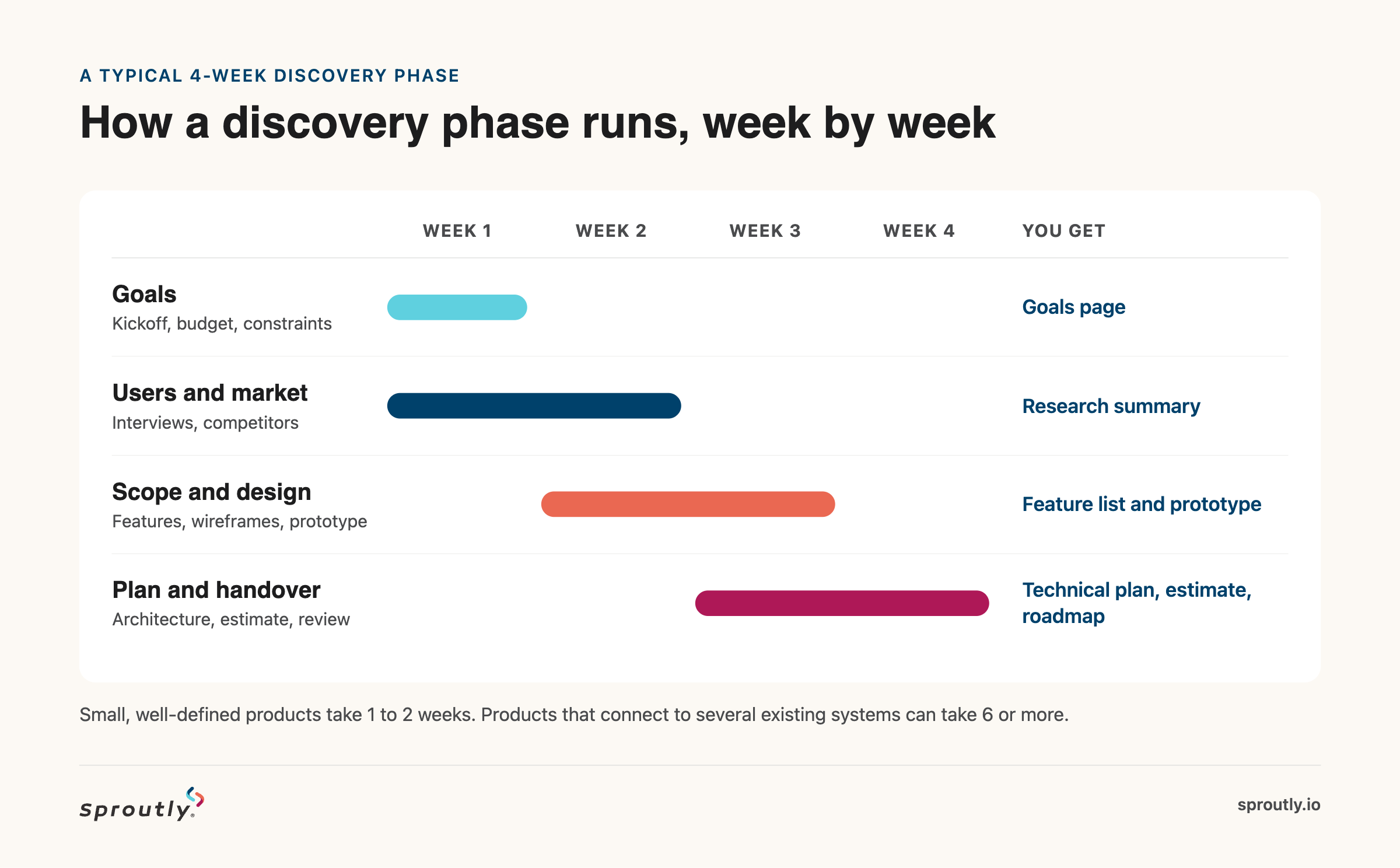
Week 1: goals and what already exists. A kickoff workshop covers your goals, budget, launch date, and constraints. The team reads whatever you already have: a pitch deck, sketches, the spreadsheets the product will replace, or an old app.
Weeks 1 to 2: users and the market. The team talks to target users about how they handle the problem today. They also look at competitors and at the workarounds people use instead, which are often a spreadsheet and a lot of email.
Weeks 2 to 3: scope and design. The feature list takes shape first, then user flows and wireframes, then a clickable prototype that a few target users try out. Their feedback trims the list. In parallel, the tech lead checks what is feasible and tests the riskiest piece.
Weeks 3 to 4: plan, estimate, and handover. The team writes the technical plan, the estimate, and the roadmap. The phase ends with a review session where you walk through every document and push back on anything you do not understand.
Your part. You make the calls, and discovery stalls without you. Expect workshops, decisions between sessions, and introductions to the users the team should talk to.
Who is on a discovery team, including you
A discovery team is small, and on a founder-sized product 1 person often covers 2 of these roles.
|
Role |
What they do in discovery |
|
Business analyst or product manager |
Runs the workshops; writes the scope and user stories |
|
UX/UI designer |
Draws the user flows and wireframes; builds and tests the prototype |
|
Solution architect or tech lead |
Writes the technical plan; tests the riskiest piece; checks the estimate |
|
Project manager (often the business analyst) |
Keeps the schedule; drafts the roadmap |
|
You , plus 1 person who knows your customers |
Make the decisions; open doors to users; sign off on each document |
Ask whether the people doing discovery will also build the product. If they will not, ask how their knowledge reaches the build team, beyond the documents themselves.
How long a discovery phase takes and what it costs
There is no reliable market average, because each vendor scopes discovery differently. A few vendors publish their own numbers:
|
Source |
Duration |
Price |
Note |
|
Leanware |
2 to 4 weeks |
$5,000 to $15,000, fixed |
The vendor's own published price |
|
Innowise |
1 to 2 weeks (small project), 4 to 6 weeks (large) |
Not published |
|
|
Stfalcon |
2 to 3 weeks (mid-sized project), 4 to 6 weeks (large) |
Not published |
Published by each vendor on its own website, checked November 9, 2026. Your project's price depends on its scope.
Within any vendor's range, 4 things move the price:
- How many user types and workflows the product has. A booking app with 1 type of user takes less mapping than a marketplace with buyers, sellers, and an admin team.
- How many systems it must connect to. Each integration (payments, a CRM, an existing database) needs its own check.
- How much is technically uncertain. A familiar web app needs little testing up front. A product that depends on a third-party API nobody on the team has used needs a proof of concept.
- Whether user research is included. If you bring your own interviews and data, the team can spend less time collecting them.
Discovery is usually sold at a fixed price, because the output can be defined before the work starts. Our guide to [software development engagement models](LINK when live: https://www.sproutly.io/blog/software-development-engagement-models) explains why that fits and how the build after it is usually priced. For what the build itself costs, see [how much it costs to build an app](LINK: Oct 29 cost hub, confirm slug).
Do you need a discovery phase?
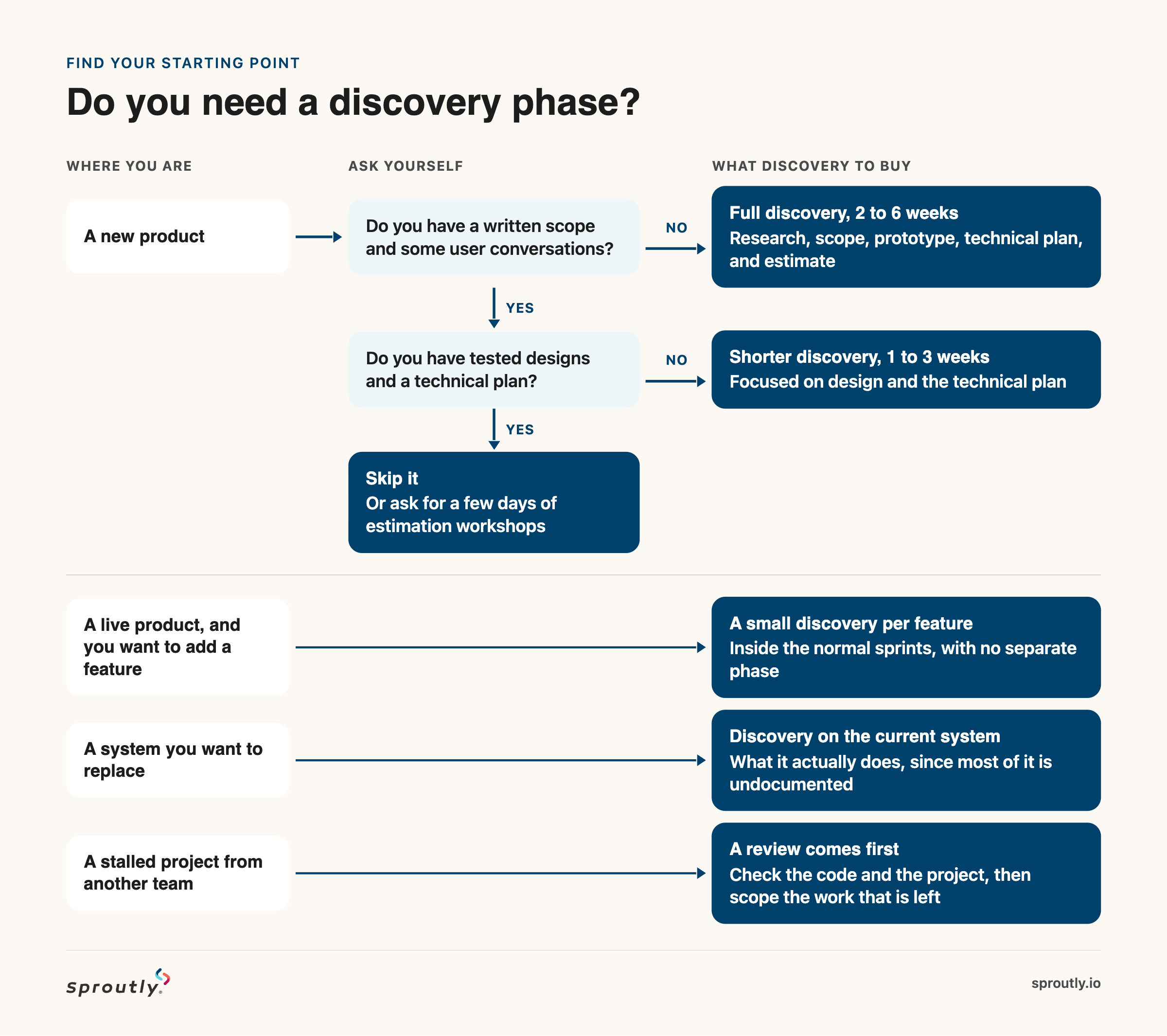
Find the row that matches what you have today.
|
What you have now |
What discovery to buy |
|
An idea, no user conversations, no written scope |
Full discovery: research, scope, prototype, technical plan, and estimate |
|
A 1-page scope and some user conversations, no designs or technical plan |
A shorter discovery focused on design and the technical plan (1 to 3 weeks) |
|
A detailed scope, tested designs, and a team that knows your industry |
Skip it, or ask for a few days of estimation workshops |
|
A live product, and you want to add a feature |
A small discovery for each feature inside the normal sprints, with no separate phase |
|
A system you want to replace (spreadsheets, an old app) |
Discovery focused on what the current system actually does, since most of it is undocumented |
|
A stalled project from another team |
A review of the code and the project first, then discovery for the work that is left |
If you are in row 2 and want to do part of the work yourself, start from our 1-page MVP scope template . A filled-in scope can shorten discovery by a week or more, because the team starts from your answers.
A vendor who offers to start coding next week on a 2-paragraph brief still has to answer the discovery questions. They answer them during the build, at build rates, and you see the answers as change requests.
If you are in the last row, look first at the signs a project has stalled . An outside review of what is there will tell you how much discovery is left to do. Schedule a team assessment for an independent, plain-language read.
6 questions to ask before you pay for discovery
- What exactly will I have in writing at the end? A good answer is a list close to the 7 documents above, in formats you can open without the vendor's tools.
- Do I own the outputs, and can I take them to another team? The answer should be yes, in the contract. If the vendor hesitates, assume the documents are part of their sales process.
- Is the price fixed, and what happens if discovery shows the idea should change? A fixed price with a defined end is standard. Ask whether a change of direction halfway through restarts the clock or the bill.
- Who on your team does the work, and will they also build the product? Discovery done by a senior team and a build handed to a junior one loses context along the way.
- How much of my time does it need each week? A realistic answer names sessions and hours. "Very little" usually means the team will fill the gaps with assumptions.
- Will you tell me if the answer is "do not build this yet"? A vendor that has told a client this before can usually describe when it happened and what the client did next.
3 red flags to watch for:
- Free discovery that is really a sales meeting. A 1-hour call can tell you whether a team is a good fit. It cannot produce a scope or an estimate you can rely on.
- Open-ended hourly discovery. With no end date and no deliverables list, discovery can run as long as your budget allows.
- A firm estimate in the proposal before discovery starts. If the build price is already fixed, either discovery will not change it, or the number is a guess.
Once discovery ends and the build starts, a different set of risks takes over. Our guide to IT outsourcing risks and how to control them covers them. About to scope a build? Schedule a free consultation.
Already working with a team that has stalled? Schedule a team assessment .
References
- CB Insights (March 5, 2026). "The top reasons startups fail." CB Insights
- Project Management Institute (August 2014). Pulse of the Profession In-Depth Report: Requirements Management, A Core Competency for Project and Program Success. PMI
- Torres, T. (2021). Continuous Discovery Habits: Discover Products that Create Customer Value and Business Value. Product Talk LLC. Product Talk
- Cagan, M. (2017). Inspired: How to Create Tech Products Customers Love , 2nd edition. Wiley.
- Leanware. "Project discovery phase cost: Sprint 0 pricing explained." Checked November 9, 2026. Leanware
- Innowise. "Discovery phase in software development." Checked November 9, 2026. Innowise
- Stfalcon. "Discovery phase in software development." Checked November 9, 2026. Stfalcon
FAQ
How long does a discovery phase take?
A discovery phase usually takes 2 to 6 weeks. A small product with 1 type of user and few integrations can be scoped in 1 to 2 weeks, while one that connects to several existing systems, or replaces an old one, often needs 6 or more. If a vendor cannot tell you the end date before you start, the discovery itself has not been scoped.
How much does a discovery phase cost?
There is no reliable market average, because vendors scope discovery differently and few publish a price. Leanware, one that does, lists $5,000 to $15,000 for 2 to 4 weeks. The price rises with the number of user types, the systems the product must connect to, and how much is technically uncertain, so ask for a fixed price and a deliverables list.
What is the difference between a discovery phase and product discovery?
A discovery phase is a bounded stage before the build, with an end date and a set of documents. Product discovery is an ongoing practice inside a product team, testing ideas with customers every week, before and after launch. You need the first once, to start building, and the second for as long as the product is live.
Can I skip the discovery phase?
You can skip it if you already have a detailed scope, designs tested with users, and a team that knows your industry. In that case, a few days of estimation workshops may be enough. On a vague brief, skipping discovery moves the same questions into the build, where they are answered at build rates and arrive as change requests.
What happens after the discovery phase ends?
You review every document with the team, then decide whether to build, change the plan, or stop. If you build, the documents become the basis for a final estimate, or for quotes from other teams to compare. If you stop, you keep the documents for later.
Is a discovery phase the same as a proof of concept?
A proof of concept tests 1 technical question with a small piece of throwaway code, such as whether 2 systems can exchange data. A discovery phase can include a proof of concept for the riskiest part of the product. It also covers users, scope, design, and the estimate, so it answers what to build as well as whether it can be built.