
You have 2 proposals open in separate tabs and a sales call on Thursday. The partner you like best has asked for a signature by Friday, so it can hold a team for a start date 3 weeks out.
Both proposals describe a team, a timeline, and a price. Neither one says who will own the code repository, what happens when you change your mind in week 4, or what you keep if the relationship ends.
Those answers shape how MVP development outsourcing goes, and the days before you sign are when they cost the least to get. Today, each one is a question on a sales call. Once the deposit has cleared, the same question becomes a renegotiation.
Below is what to settle before signing, from whether outsourcing fits your MVP to the contract terms that protect you, with 7 questions for any MVP development partner in the middle. A checklist at the end lets you work through it all before Friday.
Before you talk to partners: check that outsourcing fits
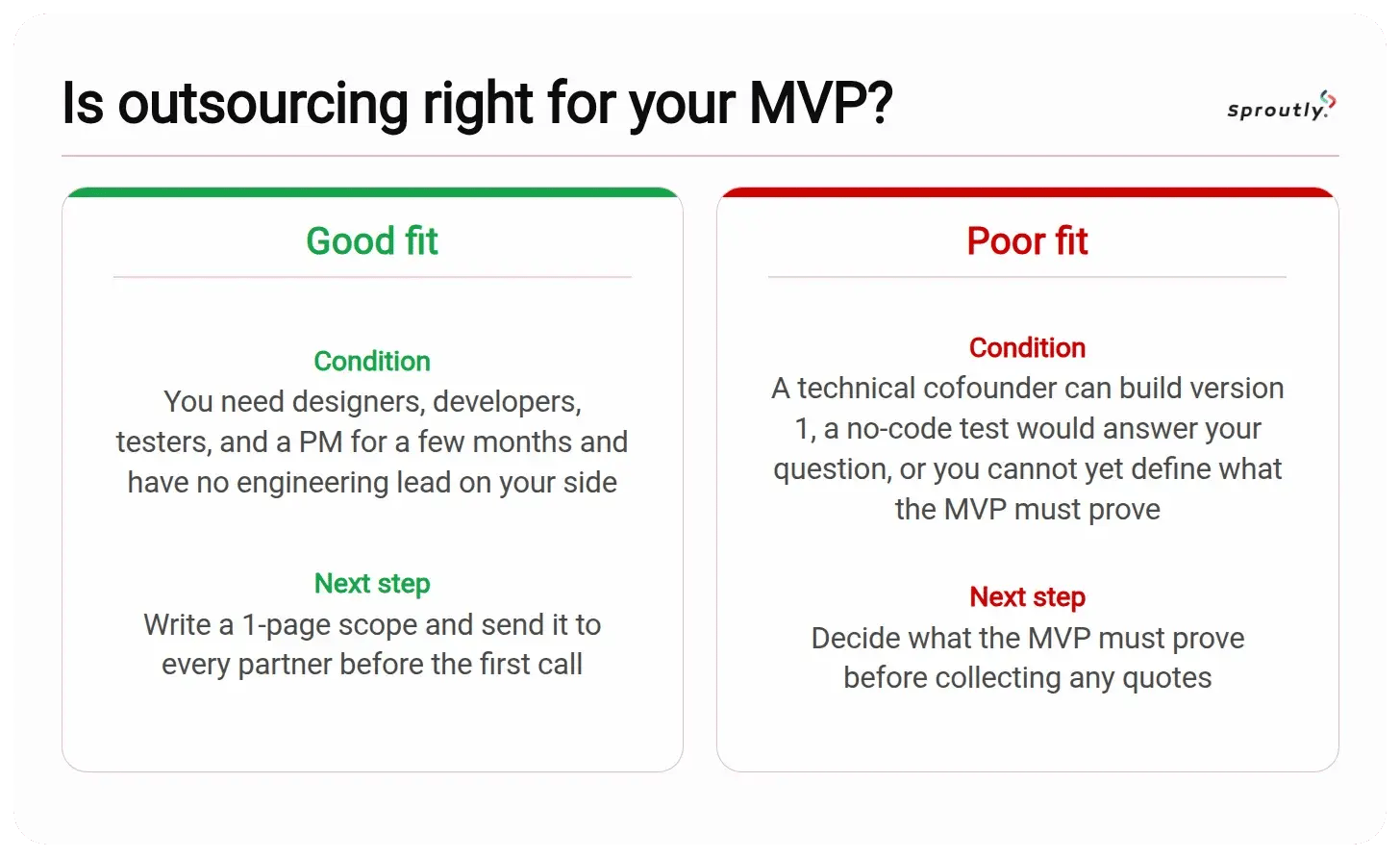
MVP outsourcing works best when the product needs designers, developers, testers, and a project manager for a few months, and no one on your side could recruit or run that group.
It is a poor fit in 3 cases:
- A technical cofounder can build version 1. If the first release fits 1 or 2 people, an outside team mostly adds invoices and meetings.
- The MVP is a demand test. A landing page, a no-code tool, or a concierge service (you deliver the service by hand to the first customers) can often answer that question for a fraction of a custom build's price.
- You cannot yet say what the MVP must prove. A capable team will build what you describe, so a vague description comes back as vague software. Decide what your MVP must prove before you collect quotes.
If none of those apply, here is how outsourcing MVP software development compares with the other 3 ways to build a first version.
| Who builds it | Fits when | Cost basis | What you still need on your side |
|---|---|---|---|
| Technical cofounder | Version 1 fits what 1 or 2 people can build | Equity, sometimes a salary | Agreed decision rights; help with design and testing |
| Freelancers | The scope is small, or you need 1 specific skill | Hourly or per project | Someone to coordinate and review their work |
| In-house hires | You expect to build the product for years | Salary plus benefits (US median developer salary: $135,980 a year) | An engineering lead to hire and manage them; weeks of recruiting per hire |
| Outsourced team (agency or development partner) | You need a full team for months and have no engineering lead | Hourly, monthly, or fixed price (rates below) | The decisions in the next section, and someone who can make the technical calls |
Salary: US Bureau of Labor Statistics, May 2025 data. A salary and a partner's hourly rate are different units, so they sit in different rows.
Write a 1-page scope before the first call
Send every partner the same short document: the problem, who has it, what version 1 must prove, and what stays out. The quotes become comparable, and the questions that come back show you who read it. Start from our 1-page MVP scope template.
If you cannot fill it in yet, some partners sell a short fixed-price discovery phase that produces the scope, early designs, and a technical plan. Check that you keep those documents if you take them to another team; software development engagement models covers how discovery is priced.
Decide what stays with you
Every proposal lists what the development partner will do. Before you sign, write down the other column: the work that stays with you once the contract starts.
| The work | Your development partner | You (or someone on your side) |
|---|---|---|
| Writing and testing code | Does the work | Clicks through it on a staging link, a private copy of the product where new work is tested |
| Technical choices (stack, hosting, architecture) | Suggests options and explains the trade-offs | Signs off, ideally after a technical reviewer on your side has looked |
| What the MVP must prove | Questions it | Makes the call |
| What gets cut when time or money runs short | Prices each option | Makes the call |
| Accepting each delivery | Shows it working | Accepts or sends it back, using written criteria |
| Accounts: code repository, cloud hosting, domain, app store listings | Works in them as an invited user | Holds them in your company's name |
| Contract, IP, and data | Signs | Negotiates and owns the outcome |
| What users say after launch | Helps gather feedback | Reads it and picks what comes next |
Put this table next to each proposal. If a proposal hands one of your rows to the partner (the partner "owns the hosting," say, or "approves releases"), raise it on the sales call while it is still a sentence in a draft.
Acceptance criteria, in the fifth row, are the conditions a feature must meet to count as done, agreed before anyone starts on it. Without them, the team decides what "done" means, and you find the gaps after the invoice is paid.
Fill the technical seat before the sales calls
3 rows (technical choices, accepting deliveries, and judging what a cut saves) need someone who can read the work. That person should also read the proposals, so find them before Thursday's call.
AI tools raise the stakes. In Deloitte's 2024 Global Outsourcing Survey of more than 500 executives, 83% said AI already plays a part in the services they outsource, and AI-assisted teams can turn out more code each week for someone to check. Veracode's 2025 GenAI Code Security Report found a flaw from the OWASP Top 10 (a widely used list of the most serious web application risks) in 45% of its tests of AI-generated code.
There are 3 common ways to get that judgment on your side:
- A technical cofounder or advisor. Usually paid in equity. An advisor with a full-time job may review a proposal but not every sprint.
- A fractional CTO. A senior technical leader who works for you part-time. Strong on architecture, hiring, and investor questions, though often not part of the weekly work with your team.
- A fractional product and technical lead. Someone who works between you and the development team every week, reviewing technical choices and checking deliveries against the criteria.
Any of the 3 can work, as long as the person is in place before you sign, while their opinion can still change the contract.
Choose how you will pay
The payment model decides how the project handles change, and an MVP exists to learn, so change is likely. Settle the model before you negotiate the price.
| Fixed price | Time and materials | Dedicated team | |
|---|---|---|---|
| How you pay | 1 price, agreed up front, for a written scope | Hourly, at agreed rates, for the time the team logs | A monthly fee that reserves a team for you |
| How it handles change | Each new idea goes back for a separate quote | New ideas go into the hours, and the total grows with them | New ideas compete for the team's existing time |
| Fits an MVP when | Version 1 is small, well defined, and unlikely to shift | You plan to learn and adjust as the build goes | The build runs for many months, or you are adding features after launch |
| Watch out for | Change quotes that push the real total well past the first number | A bill with no ceiling if no one on your side tracks the hours | The fee stays the same in a quiet month |
Our view: most MVPs do best on time and materials with a spending cap on each milestone. You keep room to change course, and every milestone has a ceiling. As the team nears it, you agree together whether to trim scope, raise the cap, or stop, which only works if someone on your side compares the hours to the cap every week.
Where the team sits changes the rate. Accelerance's 2026 survey of 60 development partners puts hourly rates at these levels:
| Region | Junior developer | Senior developer |
|---|---|---|
| Latin America | $33 to $45 | $60 to $75 |
| Europe | $31 to $39 | $50 to $76 |
| Asia | $24 to $31 | $31 to $41 |
Source: Accelerance, 2026 software development outsourcing rates (November 2025).
The rate is only part of the cost. As Accelerance's Olivier Poulard puts it, "Hourly rates are a poor measure of the true cost of software development." Shared working hours, ramp-up, and rework add to the bill, and they grow with distance. For the full comparison, see how to choose where your team sits.
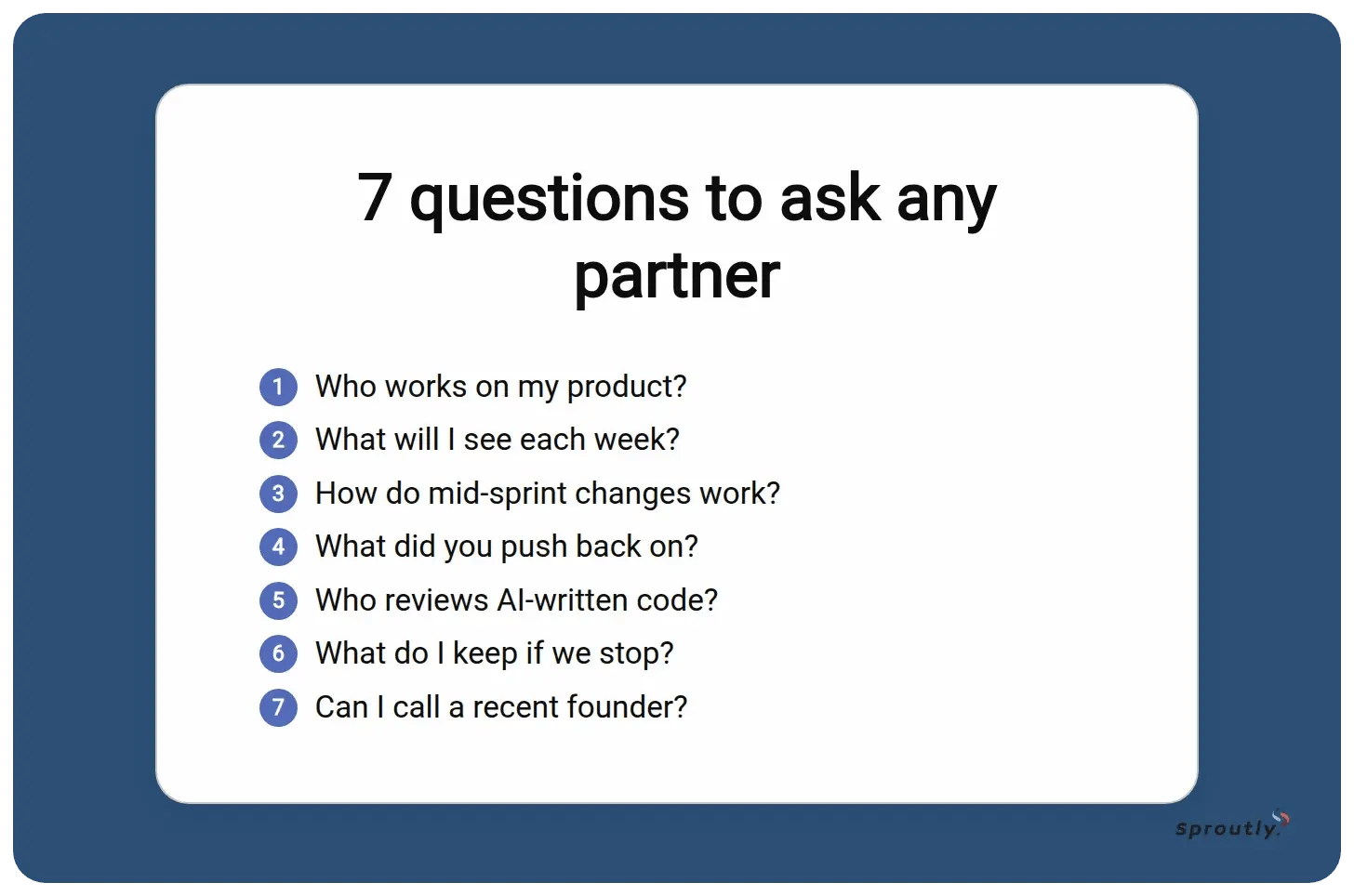
How to choose an MVP development partner: 7 questions to ask before you sign
An MVP development company comes to a sales call ready for the questions it hears every week. These 7 cover what you need to know, and each comes with what a good answer sounds like, so you can judge the reply without reading code.
1. Who will work on my product, and how much of their week is mine?
Why it matters. The people on the sales call often do not build the product, and a developer split across 4 clients moves more slowly than the proposal assumed.
A good answer sounds like: a name, role, and seniority for each person, the share of their week on your project, and who from the sales call stays involved after kickoff.
2. What will I see every week, and where?
Why it matters. A slide that says "70% complete" asks you to trust the team, while a feature you can click through lets you check for yourself.
A good answer sounds like: "Every Friday you get a staging link with the week's work running on it, and a short note on which items passed, which moved to next week, and the reason."
3. What happens when I change my mind in the middle of a sprint?
Why it matters. You will change your mind during an MVP, and this question tests the change process before you need it. (A sprint is a fixed work cycle, usually 2 weeks.)
A good answer sounds like: a written process for how a change is requested, estimated, and approved, and what happens to the work already in progress.
4. What did you push back on in your last MVP?
Why it matters. A team that agrees to every feature will happily bill you for the ones your first users never touch.
A good answer sounds like: a specific example. "The founder wanted a full admin dashboard in version 1. We suggested a spreadsheet export for the first 3 months, and they used the savings to test a second customer segment."
5. How do you use AI coding tools, and who reviews that code?
Why it matters. AI-generated code can carry security flaws (see the Veracode figure above).
A good answer sounds like: which tools the team uses, for what kind of work, and the name or role of the person who reviews AI-written code before it reaches your staging link.
6. If we stop working together, what do I walk away with?
Why it matters. Founders often change teams after launch for dull reasons, like a smaller budget or a new direction. The answer tells you whether leaving would be routine or a fight.
A good answer sounds like: "You already own the repository and the accounts, so you keep those. We also hand over the docs and passwords and give your next team 20 hours of our time." The contract section below turns that answer into terms.
7. Can I talk to a founder whose MVP you delivered in the last 12 months?
Why it matters. Client logos on a website say nothing about missed deadlines or how disagreements got settled, and a founder from last year can tell you both.
A good answer sounds like: a name and an introduction within a few days. Reviews on Clutch, which verifies reviewers, are a reasonable second check.
Read the proposal for what it leaves out
A proposal is written to win the work, so read it for gaps. When 2 quotes for the same scope sit far apart, these checks often explain much of the difference.
| Check in the proposal | Why it matters | Ask, if it is missing |
|---|---|---|
| What is in the price: design, testing, project management, deployment, app store submission | Anything left out tends to return as an extra charge | "Which of these are included?" |
| The assumptions behind the estimate | If your assumptions differ, so does the price | "What would make this estimate wrong?" |
| The payment schedule | A large deposit before any working software leaves you little to negotiate with | "Can each payment follow an accepted milestone?" |
| Running costs after launch: hosting, app store fees, paid services | Someone pays these every month once users arrive | "Which running costs will I pay, and roughly how much?" |
| Reused components and in-house tools | Your next team may need a license to keep using them | "What will you reuse, and what license do I get?" |
| Fixes after launch | The first real users find bugs the team missed | "For how long do you fix defects at no extra charge?" |
Reused components are a common start of vendor lock-in, which that guide covers in depth.
5 contract terms to get in writing before you sign
This section is general information about US law, not legal advice. Have a lawyer review your contract, especially if your development partner is based in another country.
1. A written copyright assignment
Many development contracts call the work "work made for hire." For software written by an outside company, that phrase alone usually does not make you the owner.
Under the US Copyright Act, work commissioned from someone who is not your employee counts as a work made for hire only if it falls into 1 of 9 categories and both sides sign a written agreement saying so. The 9 categories are contributions to a collective work, parts of a motion picture or other audiovisual work, translations, supplementary works, compilations, instructional texts, tests, answer material for tests, and atlases (US Copyright Office, Circular 30). Software code is not on the list.
So the contract needs a written assignment of copyright to your company, and many lawyers add it as a backup to the work-made-for-hire language. Also ask whether the partner's contracts with its own developers assign their work to the partner, so the chain reaches you.
2. Accounts in your name from day 1
Open the code repository, cloud hosting, domain, analytics, and the Apple and Google developer accounts under your company, then add the partner as a user. The bills, and the final say over access, stay with you.
Moving an account later needs the other side's help. On Apple's App Store, the Account Holder who has the app starts a transfer, and the receiving Account Holder accepts it (Apple, App Store Connect Help). Write into the contract that your app is published under your account.
3. Acceptance criteria tied to payments
Write down what "done" means for every milestone, and release each payment only after you have signed off on that milestone. Both sides then work to the same finish line, and you have a built-in reason to test each delivery before you pay for it.
4. A change process
Spell out the path for a new idea: who puts it in writing, how the team prices it, and who approves the price before work starts. The partner is protected from unpaid extra work, and you are protected from charges you never agreed to.
5. Exit and handover terms
Agree in advance how much notice either side gives, when the source code and documentation come to you, how many hours the partner spends briefing your next team, and that confidentiality outlasts the contract. With a partner abroad, the contract should also name the country whose law applies and how disputes get settled.
A non-disclosure agreement (NDA) protects the confidential material you share, such as your idea, your data, and your plans. A reputable partner signs one without fuss, and the 5 terms above handle everything an NDA leaves out.
Agree now how you will see progress, and how you would leave
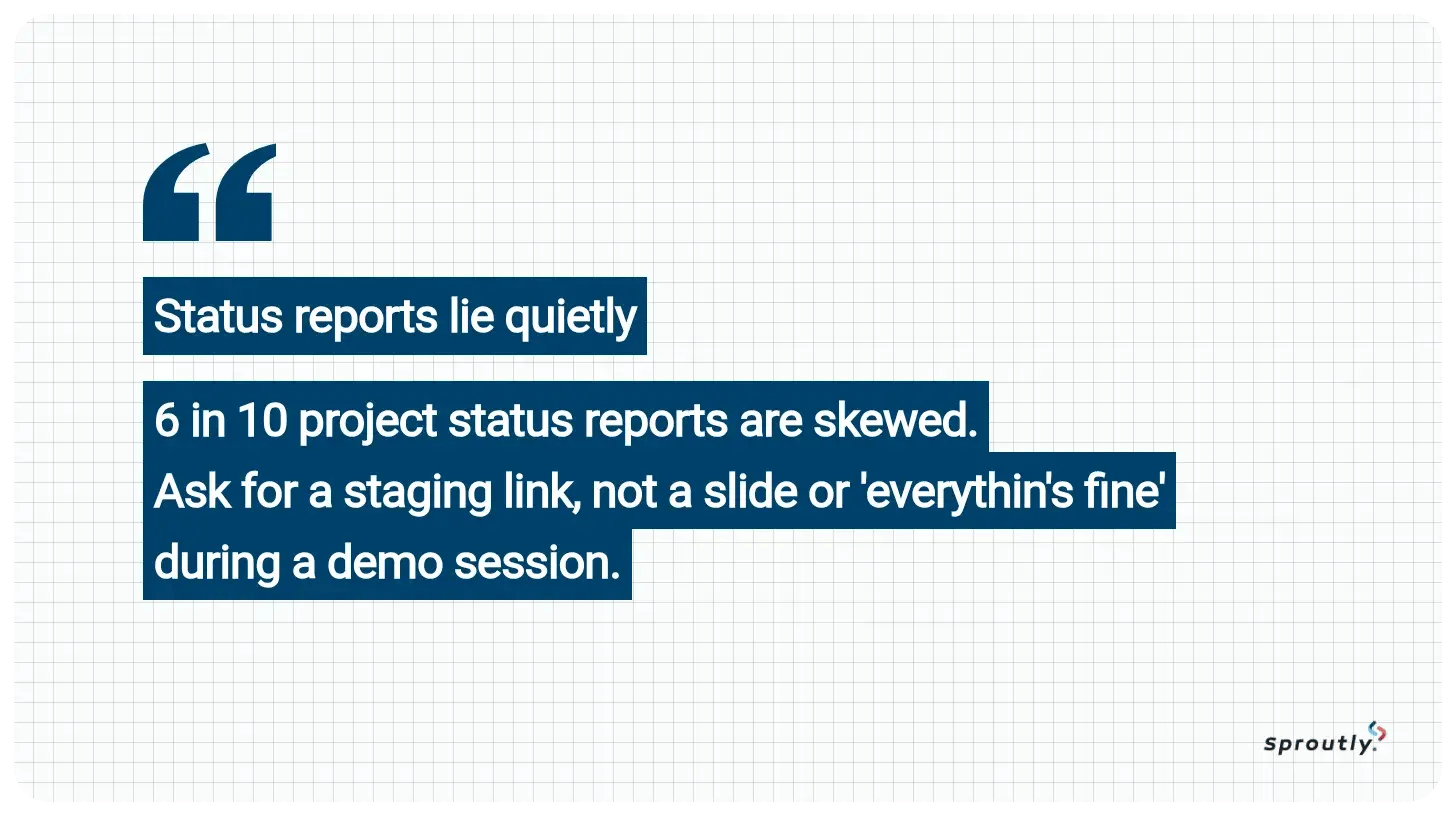
Status reports on their own tell you less than they seem to. When Snow, Keil, and Wallace (2007) surveyed 56 experienced software project managers, 6 in 10 reports turned out to be skewed, and rosy skews outnumbered gloomy ones 2 to 1. No one has to lie for that to happen, because people describing their own progress tend to round up.
So write the evidence you will get into the statement of work:
- A staging link from week 2, updated every sprint, so you can try each feature the team calls done.
- Written sign-off on every milestone against the acceptance criteria, with payment after it.
- A standing question at every check-in, answered in writing: "What is most likely to make us miss the next milestone?"
Once the build starts, watch for these signs your dev team is behind.
Attach a handover list to the contract
You may stay with the same partner for years, or version 2 may need skills the first team lacks. Either way, list what you will hold at launch in a contract appendix:
- Owner access to the code repository, with the partner as a user.
- Hosting, domain, and the Apple and Google developer accounts in your company's name, with the app published under yours.
- Deployment documentation that lets a new team release an update without phoning the original developers.
- A list of third-party services (payments, email, maps, analytics), with who pays for each and where the keys are stored.
- Test accounts for every user type, plus a short architecture note: 1 or 2 pages on how the parts connect and why the main technical choices were made.
Tow Ninja, a towing app, reached Sproutly halfway through its MVP, after the first developer had stepped away. We reviewed the code, fixed the most urgent problems, added automated tests and releases, and finished the missing features. The pilot went live and passed the city's reporting rules: read how we finished a partial MVP.
MVP development outsourcing checklist: what to settle before you sign
Work through the table in order. Each row has a test that tells you when to move on.
| Step | Settle this | Done when |
|---|---|---|
| Fit and scope | Outsourcing suits this MVP, and a 1-page scope exists | Every partner has quoted the same document |
| Your side | A technical reviewer is in place | That person has read every proposal, and none hands your rows to the partner |
| Payment model | Fixed price, time and materials with caps, or a dedicated team | The model matches how much you expect the scope to change |
| Partner | The 7 questions and 1 founder reference call | You have the answers in writing |
| Proposal | The 6 proposal checks | Every gap has a written answer |
| Ownership | A written copyright assignment, covering the partner's developers | A lawyer has read the clause |
| Accounts | Repository, hosting, domain, and app store accounts | They exist in your company's name before kickoff |
| Payments and changes | Acceptance criteria per milestone, and a written change process | Payment follows sign-off, and you know who approves a change |
| Visibility and exit | Staging link, sign-off routine, and the handover list | All 3 are in the statement of work or an appendix |
How Sproutly helps
Sproutly's work starts before a contract exists. Edge Sourcing™ begins with the scope: we help you pin down what version 1 has to do, introduce you to a development partner we have vetted, and assign a fractional product and technical lead (we call them Edge Facilitators), who reads the proposal and the contract with you.
After kickoff, you, the partner, and your Edge Facilitator share 1 set of tools and 1 way of working, so early warning signs reach all 3 of you at once. Our development partners are based in India and Eastern Europe.
- Tow Ninja came to us with a partial MVP and launched its pilot. Read how we finished a partial MVP.
- A large US school district uses an application Sproutly built, now developed by a partner team, with a Sproutly cofounder as the district's Edge Facilitator.
You can also browse more client stories.
References
- US Bureau of Labor Statistics. Occupational Outlook Handbook: Software Developers, Quality Assurance Analysts, and Testers. May 2025 wage data. BLS
- Deloitte (2024). 2024 Global Outsourcing Survey. Deloitte
- Veracode (2025). 2025 GenAI Code Security Report. Veracode
- Accelerance (2025). Price Pressure and Performance: The New Equation for Global Dev Rates. November 24, 2025. Accelerance
- US Copyright Office (2024). Circular 30: Works Made for Hire. Revised August 2024. copyright.gov
- BitLaw. "Copyright ownership." BitLaw
- Apple. "Overview of app transfer." App Store Connect Help. Apple Developer
- Snow, A. P., Keil, M., and Wallace, L. (2007). "The effects of optimistic and pessimistic biasing on software project status reporting." Information & Management, 44(2), 130 to 141. Academia.edu
FAQ
Is outsourcing MVP development a good idea?
For many founders, yes. It fits when you need a full team for a few months and have no engineering lead, as long as someone on your side can make the technical calls. It is a poor fit when a technical cofounder can build version 1, when a landing page or no-code test would answer your question, or when you cannot yet say what the MVP must prove.
What should I check before signing an MVP development contract?
Check 5 terms: a written copyright assignment, accounts in your company's name, acceptance criteria tied to payments, a written change process, and exit and handover terms. In the proposal, look for what is excluded, the assumptions behind the estimate, and the size of the deposit. Have a lawyer review the contract before you sign.
How much does it cost to outsource MVP development?
The cost depends on scope, the number of platforms, where the team sits, and the engagement model. Accelerance's 2026 data puts senior developer rates at $60 to $75 an hour in Latin America, $64 to $76 in Europe, and $31 to $41 in Asia. Scope moves the total most, so cut features before you compare quotes.
Who owns the code when you outsource MVP development?
You own it only if your contract assigns the copyright to your company in writing. Under US law, a "work made for hire" clause usually does not cover software written by an outside company, because software is not one of the 9 categories the law allows for commissioned work. Have a lawyer check that your contract includes a written assignment.
Should I choose fixed price or time and materials for an MVP?
For most MVPs, time and materials with a budget cap per milestone works better. An MVP exists to learn, and fixed-price contracts turn every change into a new quote. Fixed price fits a small, tightly defined scope with few expected changes. With either model, someone on your side should check progress against the budget every week.
Can I switch development partners after the MVP?
Yes, if the accounts are in your company's name and the contract includes handover terms. The easiest time to arrange both is before you sign: open the accounts yourself, and attach a handover list to the contract covering code access, deployment documentation, and third-party services.